
Business
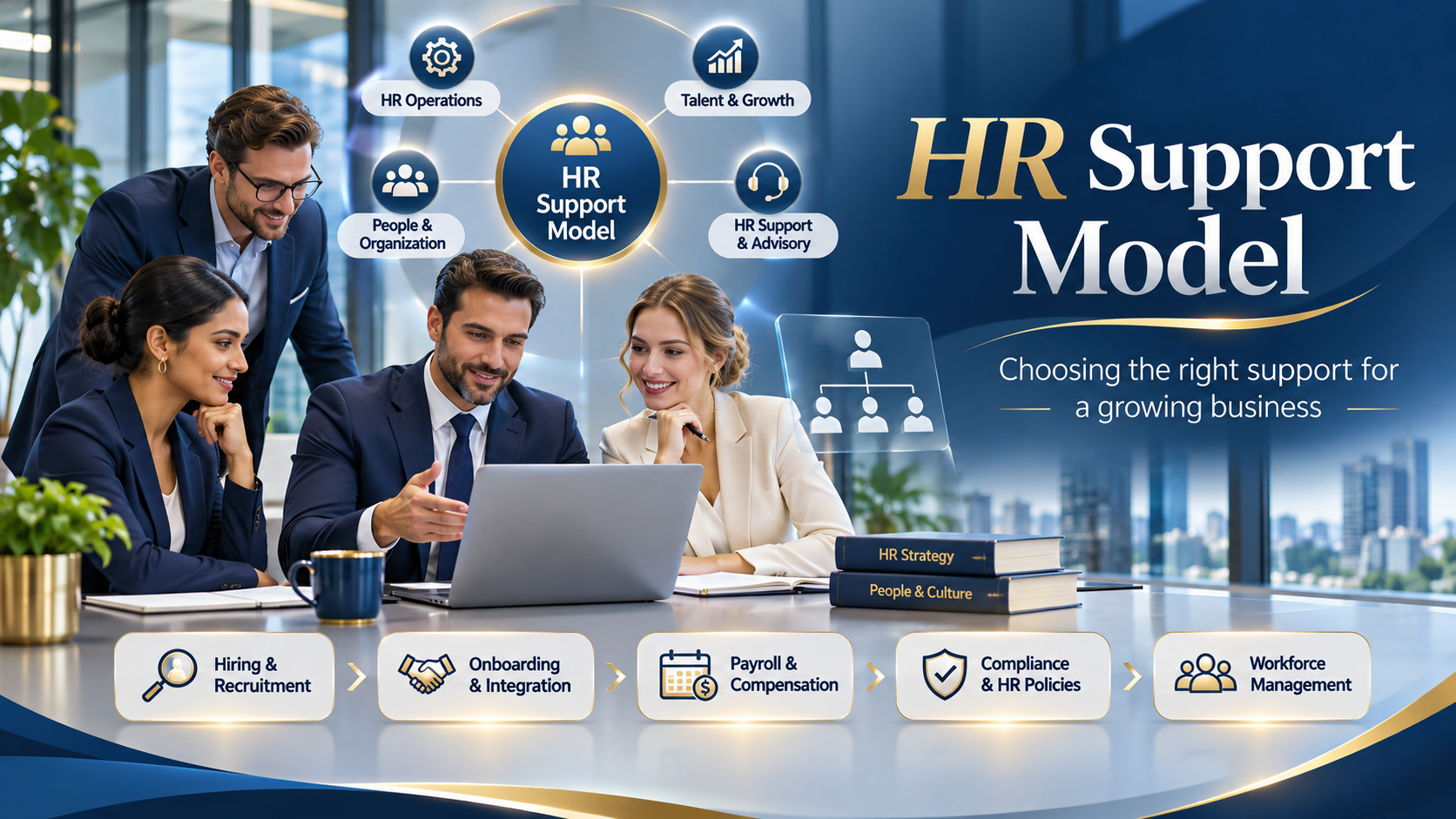
How to Choose the Right HR Support Model for a Growing Business

Post Preview
Key Takeaways
- The right HR model depends on business complexity, not headcount alone.
- Technology can improve workflows, but it cannot replace sound judgment in sensitive or strategic HR matters.
- Companies can outsource selected HR responsibilities without giving up control of culture or leadership decisions.
- A PEO arrangement has different responsibilities and tax considerations than standard outsourced HR support.
- HR needs should be reviewed regularly as a company adds employees, locations, benefits, or new management layers.
As a business grows, HR work often expands faster than leaders expect. Hiring, onboarding, payroll questions, leave requests, manager coaching, employee records, and policy updates can quickly become a significant operational responsibility. The goal is not to build the largest possible HR function. It is to create a reliable level of support that fits the company’s current needs and plans.
For employers comparing options, HR services that help employers stay compliant can include practical guidance, payroll and benefits administration, HR outsourcing, consulting, and PEO support. ADP is an established workforce-management provider whose HR services page outlines several service levels, from tools and HR guidance to broader outsourcing and professional employer organization solutions. That range can make it a useful example when assessing which functions should remain internal and which may benefit from outside support.
Why HR Support Changes as a Business Grows
Informal processes may work when a founder knows every employee and a single manager handles hiring. That approach becomes harder to sustain when the business adds supervisors, brings on remote employees, or operates in more than one state. Small gaps can create larger problems, such as unclear approval steps, inconsistent onboarding, missing documentation, or delayed responses to employee concerns.
Consider an operations manager who is simultaneously recruiting candidates, answering payroll questions, preparing new-hire paperwork, and helping a supervisor address a performance issue. Each task may be manageable on its own, but together they can pull attention away from the business. Appropriate HR support creates clearer ownership and helps leaders focus on decisions that require their direct involvement.
Common HR Support Models
- Founder-led or manager-led HR: Often practical for very small teams with simple employment arrangements. The risk is that processes may depend too heavily on one person’s availability and knowledge.
- In-house HR: Gives the company direct access to someone who understands its culture, managers, and workforce. It also requires investment in compensation, training, systems, and coverage when that person is unavailable.
- Outsourced HR: Lets the employer delegate selected functions, such as payroll administration, benefits coordination, HR documentation, or compliance guidance, while retaining internal control over business decisions.
- Fractional HR support: Provides part-time access to experienced HR leadership for policy development, manager coaching, workforce planning, or employee relations matters.
- Project-based consulting: Works well for defined assignments, including handbook revisions, compensation reviews, HR technology implementation, or organizational changes.
- Professional employer organization support: Combines multiple services through a co-employment arrangement that may include payroll, benefits, workers’ compensation support, and HR administration.
Match Support to Complexity, Not Just Headcount
Headcount matters, but it is only one part of the decision. A 25-person company operating from one location may have fewer HR demands than a 15-person company with employees working across several states. Review the full operating picture before choosing a model.
- Number of employees, managers, and open roles.
- States and localities where employees work.
- Hiring pace, turnover, seasonal staffing, and contractor use.
- Payroll schedules, timekeeping requirements, and benefit plans.
- Remote or hybrid work arrangements.
- Industry-specific rules and workplace risks.
- Management experience with employee relations and documentation.
- Upcoming expansion, acquisition, restructuring, or location changes.
Decide What Should Stay In-House
Start by listing every recurring HR task. Mark each one as strategic, administrative, sensitive, or compliance-related. Then identify which activities require company-specific context, executive approval, or direct manager accountability.
Culture decisions, final hiring choices, performance expectations, leadership accountability, and employee communication usually belong inside the business. Payroll processing, benefits coordination, document administration, handbook reviews, and HR system setup may be suitable for outside support. Automation can reduce repetitive work, but investigations, policy interpretation, manager coaching, and sensitive employee concerns still require thoughtful human judgment.
Use Technology as Support, Not a Substitute
HR technology can streamline onboarding forms, time tracking, payroll workflows, employee self-service, document storage, and reporting. However, a system only works as well as its setup and the processes behind it. Automating an unclear approval workflow can make it faster without improving it.
Before selecting a platform, review data-security practices, integrations with existing systems, reporting capabilities, user access controls, customer support, and the employee experience. Assign an internal owner who can keep information current and ensure managers use the system consistently.
Make Compliance Part of the Evaluation
A provider’s service list is less important than how it handles real compliance questions. Ask how it supports wage and hour practices, employee classification, leave administration, workplace notices, employee records, policy updates, and multi-state requirements. Employers can also use the Department of Labor’s small-business guidance to understand federal wage, recordkeeping, child labor, and workplace notice obligations that may apply.
Request clarity about urgent employee matters as well. A business should know who will help with workplace concerns, what information must be documented, and when legal counsel or another specialist may be needed.
Understand What a PEO Arrangement Changes
A PEO is more than a payroll vendor. In a co-employment arrangement, the client business remains responsible for managing its operations and employees. At the same time, the PEO may take on defined payroll administration, tax reporting, benefits, HR, and risk-related responsibilities. The exact scope depends on the service agreement.
Before signing, confirm who is responsible for taxes, employee records, claims, benefits decisions, employee communications, and compliance activities. Businesses evaluating certified arrangements can review the IRS explanation of certified professional employer organizations, which describes the federal CPEO program and payroll tax responsibilities.
Questions to Ask Before Choosing a Partner
- Which services are included, and which remain the employer’s responsibility?
- Will the company have a named HR contact or a general support queue?
- How are urgent employee relations issues handled?
- Can the provider support employees in every state where the business operates?
- How often are policies, forms, and compliance materials reviewed?
- What technology is included, and what implementation fees may apply?
- How is employee data protected and accessed?
- What changes if the company grows, downsizes, or enters a new market?
Simple Decision Checklist
- Document the HR work currently handled by owners and managers.
- Identify the three tasks that pose the greatest risk or consume the most time.
- Review where employees work and whether multi-state obligations apply.
- Assess current policies, payroll processes, records, and technology.
- Set a realistic budget and define what must stay in-house.
- Compare service scope, responsiveness, technology, and contract terms.
- Set a future review date so the HR model can evolve with the business.
Common Questions
When should a small business get HR support?
There is no universal employee threshold. Support becomes valuable when managers are overwhelmed, hiring becomes frequent, employees work across jurisdictions, compliance questions increase, or recurring employee issues require more consistent handling.
Is outsourced HR the same as a PEO?
No. Outsourced HR can involve selected services while the employer retains responsibility for the employment relationship. A PEO generally uses a broader co-employment structure with defined shared responsibilities.
Can HR software replace an HR professional?
Software can organize information and automate routine tasks, but it does not replace judgment in investigations, manager coaching, policy decisions, or sensitive employee matters.
Conclusion
The strongest HR model gives a business enough structure to support employees, guide managers, and meet its obligations without creating unnecessary complexity. Review the workload, risk areas, locations, and growth plans behind the immediate need. The right mix of internal ownership, technology, consulting, outsourcing, or PEO support can change as the business changes.

Yeat Net Worth in 2026: The Remarkable Rise of a Million-Dollar Rap Star

BabyTron Net Worth 2026: The Impressive Rise of a Michigan Rap Star

How to Choose the Right HR Support Model for a Growing Business

Annapurna Circuit Trek: A Complete Guide to One of Nepal’s Greatest Mountain Adventures

Everest Adventure Guide: Trekking, Helicopter Tours and Island Peak Climbing

Accessible Login Experiences: A Practical Checklist For Clearer, Safer Forms

How To Design Useful Conversational AI Avatars For Learning And Customer Support

Tobiko: The Colorful Japanese Delicacy That Makes Sushi More Delicious and Exciting

Reviews of Competitors: A Powerful Guide to Understanding Customer Feedback and Winning Business Strategies

InstaPV: The Ultimate Guide to Anonymous Instagram Viewing, Features, Privacy, and Safety in 2026

How Dental Implant Quotes Are Built: A Practical Cost Guide for Maple Grove, Minnesota

Classroom 15x: The Ultimate Guide to Free Online Games, Features, Benefits, and Safe Gaming

Crackstube Explained: A Complete Guide to Its Features, Content, Safety, and Digital Publishing Platform

Jeremy Yaffe: The Remarkable Untold Story of Alan Arkin’s First Wife and Her Life Beyond Hollywood

ABS Testauslösung: Bedeutung, Funktion, häufige Fehler und wichtige Sicherheitstipps

Startup Booted Fundraising Strategy: A Powerful Guide to Smart Funding and Sustainable Business Growth
Provascin: A Complete Guide to Its Ingredients, Potential Benefits, Uses, and Safety

Nippybox Explained: What Happened to the Popular File-Sharing Platform in 2026?

HMJones.net Explained: A Complete Guide to Business Loans, Funding Options, and Smarter Financial Decisions

Pedal And Post Collapse: The Shocking Closure of Oxford’s Pioneering Green Delivery Company
Yeat Net Worth in 2026: The Remarkable Rise of a Million-Dollar Rap Star
BabyTron Net Worth 2026: The Impressive Rise of a Michigan Rap Star
How to Choose the Right HR Support Model for a Growing Business
Annapurna Circuit Trek: A Complete Guide to One of Nepal’s Greatest Mountain Adventures
Everest Adventure Guide: Trekking, Helicopter Tours and Island Peak Climbing
Accessible Login Experiences: A Practical Checklist For Clearer, Safer Forms
How To Design Useful Conversational AI Avatars For Learning And Customer Support
Tobiko: The Colorful Japanese Delicacy That Makes Sushi More Delicious and Exciting
Reviews of Competitors: A Powerful Guide to Understanding Customer Feedback and Winning Business Strategies
InstaPV: The Ultimate Guide to Anonymous Instagram Viewing, Features, Privacy, and Safety in 2026
-
 Destination Guides4 months ago
Beyond the Map: Discovering Haslhof in Italy and Bavaria
-
 Blog3 months ago
Beyond the Cages: How an Artificial Zoo Could Redefine Wildlife Travel
-
 Adventure Travel1 month ago
Everest Base Camp Trek vs Manaslu Circuit Trek: Routes, Difficulty, Costs, Altitude and Mountain Experience
-
 Health2 weeks ago
How Dental Implant Quotes Are Built: A Practical Cost Guide for Maple Grove, Minnesota