
Sports
Milwaukee Bucks vs Lakers Match Player Stats: Thrilling 105–101 Result, Top Performers and Full Analysis

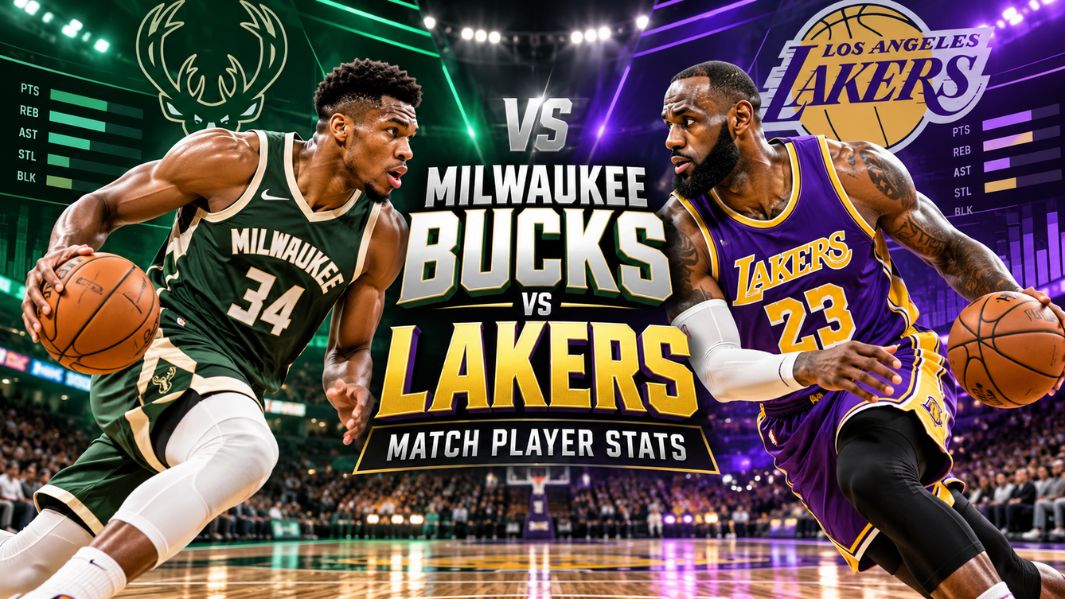
The Milwaukee Bucks vs Lakers Match Player Stats from January 9, 2026, reveal a fascinating NBA contest in which Milwaukee secured a dramatic 105–101 victory over the Los Angeles Lakers. Played at Crypto.com Arena in Los Angeles, the game featured outstanding individual performances, intense defensive pressure and a fourth-quarter battle that remained undecided until the closing seconds.
Although the Lakers enjoyed productive performances from LeBron James and Luka Dončić, Milwaukee demonstrated how efficient scoring and well-timed defensive plays can overcome impressive individual numbers. Giannis Antetokounmpo contributed 21 points while delivering two crucial defensive interventions against James in the final minute. Kevin Porter Jr. also played an essential role, leading the Bucks with 22 points and converting decisive free throws.
Beyond the final score, this matchup offered valuable insight into both teams’ offensive strategies, shooting efficiency, bench production and late-game decision-making. Understanding the complete statistics helps explain why Milwaukee emerged victorious despite facing a Lakers team capable of producing a remarkable comeback.
Milwaukee Bucks vs Lakers Match Overview
The January 9 encounter was part of the 2025–26 NBA regular season. Milwaukee entered the game looking to build momentum, while Los Angeles sought to protect its home court. The visitors eventually prevailed after surviving an impressive Lakers rally.
| Match Details | Information |
|---|---|
| Competition | NBA Regular Season 2025–26 |
| Match Date | January 9, 2026 |
| Venue | Crypto.com Arena, Los Angeles |
| Milwaukee Bucks Score | 105 |
| Los Angeles Lakers Score | 101 |
| Winning Team | Milwaukee Bucks |
| Bucks Leading Scorer | Kevin Porter Jr. – 22 points |
| Lakers Leading Scorer | LeBron James – 26 points |
| Leading Rebounder | Bobby Portis – 12 rebounds |
| Leading Playmaker | LeBron James – 10 assists |
The four-point difference highlighted the competitive nature of the contest. Milwaukee’s victory was particularly impressive because Los Angeles mounted a serious fourth-quarter comeback after trailing through much of the second half.
Milwaukee Bucks vs Lakers Match Player Stats: Complete Breakdown
Individual statistics provide the clearest picture of how both teams performed. The following tables include every player who appeared in the game, showing points, rebounds, assists and shooting numbers.
Milwaukee Bucks Player Statistics
| Player | PTS | REB | AST | FG |
|---|---|---|---|---|
| Kevin Porter Jr. | 22 | 5 | 6 | 7–14 |
| Giannis Antetokounmpo | 21 | 6 | 5 | 9–11 |
| Kyle Kuzma | 13 | 3 | 2 | 5–10 |
| Bobby Portis | 11 | 12 | 3 | 5–12 |
| AJ Green | 11 | 2 | 2 | 4–7 |
| Ryan Rollins | 10 | 6 | 2 | 2–13 |
| Myles Turner | 8 | 6 | 0 | 3–6 |
| Gary Trent Jr. | 6 | 2 | 2 | 2–5 |
| Gary Harris | 3 | 2 | 1 | 1–1 |
Milwaukee received important contributions from several players rather than depending entirely on its biggest star. Porter Jr. provided scoring and playmaking, while Antetokounmpo delivered exceptional efficiency. Portis added valuable rebounding support, and Kuzma supplied 13 points from the bench.
Los Angeles Lakers Player Statistics
| Player | PTS | REB | AST | FG |
|---|---|---|---|---|
| LeBron James | 26 | 9 | 10 | 10–21 |
| Luka Dončić | 24 | 9 | 9 | 8–25 |
| Jake LaRavia | 13 | 2 | 2 | 5–8 |
| Marcus Smart | 9 | 4 | 1 | 3–9 |
| Jarred Vanderbilt | 9 | 9 | 2 | 4–7 |
| Gabe Vincent | 6 | 2 | 2 | 2–5 |
| Jaxson Hayes | 6 | 2 | 1 | 3–6 |
| Deandre Ayton | 4 | 5 | 0 | 2–6 |
| Dalton Knecht | 4 | 1 | 0 | 2–4 |
| Maxi Kleber | 0 | 2 | 1 | 0–0 |
PTS = Points, REB = Rebounds, AST = Assists, FG = Field Goals Made–Attempted.
James and Dončić combined for 50 points, demonstrating their importance to the Lakers’ offensive production. However, the team’s supporting cast struggled to generate enough consistent scoring to overcome Milwaukee’s balanced attack.
Giannis Antetokounmpo: Efficient Scoring and Game-Winning Defense
One of the most significant stories from the matchup was Giannis Antetokounmpo’s performance. The Milwaukee superstar finished with 21 points, six rebounds, five assists, two steals and two blocks in just under 31 minutes. His accuracy was especially impressive, as he converted nine of his 11 field-goal attempts for an outstanding 81.8% shooting percentage.
Giannis displayed his familiar ability to attack the basket, finish around defenders and create opportunities for teammates. However, his most influential contribution occurred defensively. With the score tied late in the fourth quarter, he blocked a driving attempt from LeBron James, preventing Los Angeles from taking the lead. He later stripped the ball from James during another critical possession, helping Milwaukee protect its narrow advantage.
These plays illustrate why judging a player’s performance purely by points can be misleading. Antetokounmpo was not Milwaukee’s leading scorer, but his defensive timing and efficient offensive execution were essential to the victory.
Kevin Porter Jr.: Milwaukee’s Leading Scorer
Kevin Porter Jr. arguably delivered Milwaukee’s most complete offensive performance. He scored a team-high 22 points, collected five rebounds and distributed six assists. Porter also recorded four steals and one block, highlighting his active defensive involvement throughout the game.
His shooting numbers reflected a controlled performance. Porter made seven of 14 field-goal attempts and converted seven of 10 free throws. Importantly, his contributions became particularly valuable during the final seconds, when Milwaukee needed composure to secure the result.
After a defensive stop by Giannis, Porter made two free throws to break a 101–101 tie. He later added another pair from the line to secure the four-point victory. His combination of scoring, ball handling and defensive pressure gave Milwaukee an important advantage.
LeBron James: Outstanding All-Around Performance
Despite the defeat, LeBron James produced one of the game’s most impressive statistical performances. He led Los Angeles with 26 points, nine rebounds and 10 assists, narrowly missing a triple-double. He also recorded three steals while making 10 of his 21 field-goal attempts.
James remained central to the Lakers’ offensive approach. His court vision created scoring opportunities, while his attacking ability helped Los Angeles challenge Milwaukee’s interior defense. During the fourth quarter, he scored following a steal from Giannis, giving the Lakers the lead as their comeback gathered momentum.
However, the final possessions demonstrated how difficult it can be to execute against an elite defender under pressure. Giannis blocked James near the basket before forcing a late turnover. Those moments did not erase James’s strong performance, but they ultimately influenced the final result.
Luka Dončić: Strong Numbers Despite Shooting Difficulties
Luka Dončić provided another major contribution for Los Angeles, finishing with 24 points, nine rebounds and nine assists. His production showed his ability to influence multiple areas of the game, even when his shooting efficiency was below his usual standards.
Dončić converted eight of his 25 field-goal attempts, resulting in a 32% overall shooting percentage. Interestingly, he made four of six three-point attempts, suggesting that his difficulties came primarily from inside the arc. He also converted four of eight free throws.
His 12-point third quarter helped keep Los Angeles within reach. Nevertheless, foul trouble became a considerable obstacle, and he eventually fouled out with approximately 16 seconds remaining. Losing an important offensive creator at such a critical stage further reduced the Lakers’ chances of completing their comeback.
Quarter-by-Quarter Match Analysis
The scoring pattern explains how Milwaukee established control before Los Angeles nearly overturned the result.
| Quarter | Bucks | Lakers |
|---|---|---|
| First | 24 | 25 |
| Second | 37 | 27 |
| Third | 25 | 25 |
| Fourth | 19 | 24 |
| Final | 105 | 101 |
First Half: Milwaukee Builds Its Advantage
The opening quarter was competitive, with Los Angeles finishing ahead 25–24. Both teams tested each other’s defensive structure, and the narrow margin suggested a closely contested evening.
Milwaukee then took control during the second quarter, outscoring the Lakers 37–27. The Bucks demonstrated superior offensive execution and established a 61–52 halftime advantage. Their balanced scoring helped prevent Los Angeles from concentrating its defensive attention on a single player.
Second Half: Lakers Fight Back
The teams each scored 25 points during the third quarter, allowing Milwaukee to maintain its nine-point advantage entering the final period. Dončić played an important role in keeping the Lakers competitive, but his foul difficulties created additional pressure.
Los Angeles opened the fourth quarter with a 17–4 run, transforming the momentum of the game. James helped the Lakers move ahead with just over six minutes remaining, setting up a tense finish.
The score eventually reached 98–98 before Myles Turner connected on a three-pointer with 1:36 left. Jake LaRavia responded with a three-pointer to level the game again. Giannis then produced his decisive defensive plays, and Porter converted the late free throws that completed Milwaukee’s victory.
Team Shooting Statistics and Offensive Efficiency
A comparison of team shooting numbers reveals several important differences between Milwaukee and Los Angeles.
| Statistical Category | Bucks | Lakers |
|---|---|---|
| Field Goals | 38–79 | 39–91 |
| Field Goal Percentage | 48.1% | 42.9% |
| Three-Pointers | 12–34 | 15–36 |
| Three-Point Percentage | 35.3% | 41.7% |
| Free Throws | 17–22 | 8–14 |
| Free Throw Percentage | 77.3% | 57.1% |
| Assists | 23 | 28 |
| Points in the Paint | 50 | 46 |
| Bench Points | 33 | 25 |
Milwaukee’s advantage in overall field-goal accuracy was a significant factor in the outcome. Although Los Angeles made three more three-pointers and recorded more assists, the Bucks generated their points more efficiently across their shooting opportunities.
Free throws were particularly important. Milwaukee made 17 compared with Los Angeles’s eight, a difference of nine points at the line. In a game decided by four points, that disparity helps explain how Milwaukee survived despite the Lakers’ better three-point shooting.
Rebounding, Bench Strength and Defensive Contributions
Rebounding and reserve production also played meaningful roles in the contest. Bobby Portis recorded a team-high 12 rebounds, giving Milwaukee a reliable presence around the basket. He complemented those rebounds with 11 points, completing a double-double.
Jarred Vanderbilt provided valuable rebounding support for Los Angeles, collecting nine boards and contributing nine points. James and Dončić also recorded nine rebounds each, showing that the Lakers relied heavily on their primary offensive players for additional possession control.
Milwaukee received 33 bench points, compared with 25 for Los Angeles. Kyle Kuzma’s 13 points and Portis’s double-double helped the Bucks maintain offensive options beyond the starting lineup. For the Lakers, Vanderbilt’s work and Gabe Vincent’s outside shooting provided support, but the team struggled to find another consistent scoring source.
Defensively, Milwaukee benefited from Porter Jr.’s four steals and Giannis’s two blocks. These contributions were particularly important because the Lakers had enough talent to erase Milwaukee’s earlier advantage.
What the Match Statistics Reveal
The Bucks’ victory demonstrated the importance of combining efficient offense with dependable late-game execution. Milwaukee did not dominate every statistical category, but it made effective use of its opportunities and received meaningful contributions from multiple players.
For Los Angeles, the game highlighted the difference between strong individual performances and complete team production. James and Dončić delivered impressive all-around numbers, yet their combined efforts were not enough to compensate for inconsistent shooting and limited scoring elsewhere.
The absence of injured starters Austin Reaves and Rui Hachimura also affected the Lakers’ available rotation. With fewer established offensive options, Los Angeles depended heavily on its leading creators.
The broader lesson is that a close NBA game can be decided by details that traditional scoring totals do not fully capture. Defensive stops, free-throw accuracy, efficient shot selection and lineup depth all influence the final outcome.
Conclusion
The Milwaukee Bucks vs Lakers Match Player Stats from January 9, 2026, tell the story of a dramatic contest in which Milwaukee defeated Los Angeles 105–101 through efficient scoring, balanced contributions and exceptional defensive execution.
Kevin Porter Jr. led the Bucks with 22 points, while Giannis Antetokounmpo contributed 21 points and made the decisive defensive plays. LeBron James delivered 26 points, nine rebounds and 10 assists for the Lakers, supported by Luka Dončić’s 24 points, nine rebounds and nine assists.
Ultimately, Milwaukee’s stronger field-goal percentage, superior free-throw production and late-game composure proved decisive. The matchup remains a compelling example of how teamwork, efficiency and defensive discipline can determine the winner even when the opposing team features outstanding individual performances.
Frequently Asked Questions
1. Who won the Milwaukee Bucks vs Lakers game on January 9, 2026?
The Milwaukee Bucks defeated the Los Angeles Lakers 105–101 at Crypto.com Arena.
2. Who scored the most points in the Bucks vs Lakers matchup?
LeBron James led all players with 26 points, while Kevin Porter Jr. led Milwaukee with 22 points.
3. How many points did Giannis Antetokounmpo score against the Lakers?
Giannis scored 21 points, collected six rebounds and added five assists, two steals and two blocks.
4. What were Luka Dončić’s statistics against Milwaukee?
Dončić recorded 24 points, nine rebounds and nine assists, shooting eight of 25 from the field.
5. What was the biggest reason Milwaukee defeated Los Angeles?
Milwaukee combined more efficient overall shooting, better free-throw production and crucial late defensive stops to secure the four-point victory.

Swappz Explained: A Complete Guide to Its Features, Technology, Benefits, and Different Platforms

MGR Marketing: Powerful Branding Strategies, Services, and Business Growth Explained

Orchid Mantis: The Fascinating Flower-Like Predator With Extraordinary Survival Skills

South April: Discover the Unforgettable Beauty of Spring, Scenic Destinations, and Travel Experiences

Juanita Dorricott: The Remarkable Life of Bob Seger’s Wife, Her Family, Career, and Lasting Marriage

Joan Anderton: The Fascinating Life of Tim Healy’s Wife, Their Marriage and Family Story

Stacey Cooke: The Remarkable Story of Ryan Giggs’ Ex-Wife, Family Life and New Beginnings

Barbara Joyce Rupard: The Remarkable Story of Roy Clark’s Wife and Their 61-Year Marriage

Michelle Taylor: The Untold Story of Tim Meadows’ Ex-Wife, Marriage, Children, and Life After Divorce

Yvette DeLeone: The Untold Story of Scottie Pippen’s Former Fiancée and Sierra Pippen’s Mother

How Dental Implant Quotes Are Built: A Practical Cost Guide for Maple Grove, Minnesota

Classroom 15x: The Ultimate Guide to Free Online Games, Features, Benefits, and Safe Gaming

Jeremy Yaffe: The Remarkable Untold Story of Alan Arkin’s First Wife and Her Life Beyond Hollywood

ABS Testauslösung: Bedeutung, Funktion, häufige Fehler und wichtige Sicherheitstipps

Nippybox Explained: What Happened to the Popular File-Sharing Platform in 2026?

Pedal And Post Collapse: The Shocking Closure of Oxford’s Pioneering Green Delivery Company

icpfit: false Explained: Meaning, Common Causes, and Smart Ways to Fix ICP Fit Issues

Emma Poppy Deyes: The Inspiring Story of Poppy Deyes, Her Career, Family, and Lifestyle Brand

Barry Winkleman: The Remarkable Life, Publishing Career and Family Behind Claudia Winkleman

Kitty Donnelly: The Surprising Story of Johnny Vegas’ First Wife, Marriage and Life Beyond Fame
Swappz Explained: A Complete Guide to Its Features, Technology, Benefits, and Different Platforms
MGR Marketing: Powerful Branding Strategies, Services, and Business Growth Explained
Orchid Mantis: The Fascinating Flower-Like Predator With Extraordinary Survival Skills
South April: Discover the Unforgettable Beauty of Spring, Scenic Destinations, and Travel Experiences
Juanita Dorricott: The Remarkable Life of Bob Seger’s Wife, Her Family, Career, and Lasting Marriage
Joan Anderton: The Fascinating Life of Tim Healy’s Wife, Their Marriage and Family Story
Stacey Cooke: The Remarkable Story of Ryan Giggs’ Ex-Wife, Family Life and New Beginnings
Barbara Joyce Rupard: The Remarkable Story of Roy Clark’s Wife and Their 61-Year Marriage
Michelle Taylor: The Untold Story of Tim Meadows’ Ex-Wife, Marriage, Children, and Life After Divorce
Yvette DeLeone: The Untold Story of Scottie Pippen’s Former Fiancée and Sierra Pippen’s Mother
-
 Destination Guides4 months ago
Beyond the Map: Discovering Haslhof in Italy and Bavaria
-
 Blog3 months ago
Beyond the Cages: How an Artificial Zoo Could Redefine Wildlife Travel
-
 Health3 weeks ago
How Dental Implant Quotes Are Built: A Practical Cost Guide for Maple Grove, Minnesota
-
 Adventure Travel1 month ago
Everest Base Camp Trek vs Manaslu Circuit Trek: Routes, Difficulty, Costs, Altitude and Mountain Experience