
Technology
Dough Moulding Compound: A Powerful Guide to Properties, Manufacturing, Benefits, and Industrial Applications

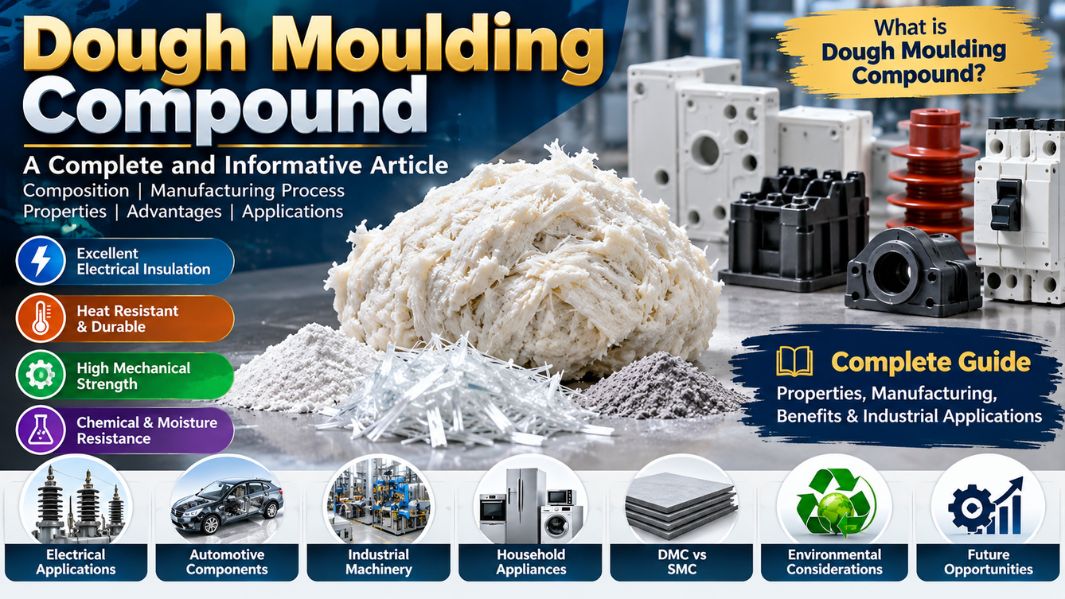
Modern manufacturing depends on materials that offer durability, precision, and reliable performance under demanding conditions. Dough Moulding Compound (DMC) is one such material, widely used to manufacture components that require electrical insulation, dimensional stability, and resistance to heat. This reinforced thermosetting composite is particularly valuable in electrical equipment, automotive components, industrial machinery, and specialized engineering products.
Unlike ordinary plastics, which may soften repeatedly when heated, DMC undergoes a chemical curing process that produces a permanently hardened structure. Its unique combination of polymer resin, reinforcing fibers, mineral fillers, and processing additives makes it suitable for manufacturing complex components with consistent properties. Understanding its composition, production methods, advantages, and limitations helps engineers and manufacturers determine where this material can deliver practical value.
What Is Dough Moulding Compound?
Dough Moulding Compound is a mouldable composite material consisting primarily of a thermosetting resin, short reinforcing fibers, mineral fillers, and carefully selected additives. It gets its name from its soft, dough-like consistency before processing. Once exposed to controlled heat and pressure inside a mould, the mixture flows into the required shape and undergoes an irreversible curing reaction.
The material is closely related to Bulk Molding Compound (BMC), and modern manufacturing often uses the two names interchangeably. Historically, certain DMC and BMC formulations differed, particularly in their use of thickening agents. However, both commonly refer to reinforced thermosetting molding compounds used in industrial production.
One key characteristic is their ability to combine several functional properties in a single molded component. Depending on the formulation, manufacturers can achieve excellent electrical insulation, controlled dimensional accuracy, mechanical strength, and resistance to specific environmental conditions.
Composition and Main Ingredients of DMC
This engineering material’s performance depends heavily on its formulation. Manufacturers adjust ingredient proportions and types to meet specific industrial requirements. Although compositions vary, most conventional formulations share several important components.
Thermosetting Resin
The resin forms the continuous matrix that binds the other ingredients together. Unsaturated polyester resin is commonly used because it offers a practical balance of cost, processing characteristics, and mechanical performance. Other thermosetting systems, including selected vinyl ester or epoxy formulations, may be used for specialized requirements.
During molding, the resin crosslinks, creating a rigid polymer network. This reaction gives the finished product its permanent shape and prevents it from behaving like a conventional remeltable thermoplastic.
Glass Fiber Reinforcement
Short glass fibers improve the compound’s strength, stiffness, and structural performance. Many formulations contain chopped fibers several millimetres long, although the exact length and concentration depend on the intended application.
Reinforcement helps distribute mechanical loads through the component. However, fiber dispersion, orientation, and bonding with the resin strongly influence final performance.
Mineral Fillers and Additives
Mineral fillers such as calcium carbonate are often added to control material costs, improve processing, and improve dimensional stability. Other fillers may be selected to meet specific thermal, electrical, or flame-performance requirements.
Additional ingredients can include curing initiators, pigments, internal mold-release agents, processing aids, and low-shrink additives. Each ingredient serves a specific purpose, and changing one component can affect several properties at once.
How Dough Moulding Compound Is Manufactured
Producing DMC involves controlled preparation, mixing, moulding, and curing. The process must distribute the ingredients evenly while preserving enough fiber length to provide effective reinforcement.
Preparation and Mixing
Manufacturing begins with preparing the resin system and blending it with the required fillers, pigments, curing ingredients, and other additives. Chopped glass fibers are incorporated using suitable mixing equipment, such as specialized kneaders or industrial mixers.
The objective is to create a uniform, workable compound without excessively damaging the reinforcing fibers. Mixing conditions matter because poor dispersion can create weak areas, uneven surfaces, or inconsistent performance.
The prepared compound may be supplied in bulk quantities or formed into manageable portions for subsequent moulding operations.
Compression Moulding
Compression molding is an established processing method for this material. A measured quantity of compound is placed inside a heated mould cavity. The mould closes under pressure, causing the material to flow and fill the required geometry.
Heat activates the curing reaction, transforming the soft compound into a hardened product. Once sufficient curing has occurred, the mould opens, and the component is removed.
Processing conditions depend on the resin formulation, component thickness, mould design, and equipment. Controlling pressure, temperature, and curing time carefully is essential for repeatable production.
Injection and Transfer Moulding
Some DMC formulations can also be processed with injection molding or transfer molding equipment designed for thermosetting compounds. These techniques can be useful when manufacturing components with intricate shapes, closely controlled dimensions, or demanding production requirements.
However, equipment selection must account for material flow, fibre behaviour, curing characteristics, and the risk of premature hardening inside the processing system.
Important Properties of Dough Moulding Compound
Excellent Electrical Insulation
One of the most valuable features of a well-formulated DMC is its ability to act as an electrical insulator. This makes it useful in switchgear, circuit breakers, contactors, terminal supports, and related electrical assemblies.
Its dielectric properties can help prevent unwanted electrical conduction between components. Nevertheless, electrical performance must be verified for the intended voltage, operating temperature, moisture exposure, and applicable safety requirements.
Heat Resistance and Dimensional Stability
DMC products can retain their shape and functional properties under elevated temperatures when the correct grade is selected. Their crosslinked structure prevents conventional thermoplastic melting, although excessive heat can still cause degradation or mechanical deterioration.
Good dimensional stability is another important advantage. Properly formulated compounds can maintain accurate shapes under changing operating conditions, making them suitable for applications where alignment, fit, and component tolerances matter.
Mechanical Strength and Durability
Glass fiber reinforcement improves stiffness and strength compared with an equivalent unreinforced resin. These characteristics let molded components withstand routine mechanical loads and handling.
However, performance depends on fibre concentration, processing quality, design geometry, and loading direction. DMC is not automatically stronger than every alternative composite or engineering plastic, particularly where high impact resistance is required.
Chemical and Moisture Resistance
Certain formulations offer useful resistance to oils, greases, water exposure, and selected chemicals. This makes them suitable for industrial environments where components may encounter contaminants during operation.
Chemical compatibility must still be evaluated individually because some solvents and aggressive substances can damage the resin system. No single formulation provides universal chemical resistance.
Major Industrial Applications of Dough Moulding Compound
Electrical and Electronic Equipment
The electrical industry is among the most important application areas for this material. Manufacturers use suitable grades to produce insulating supports, electrical housings, switchgear components, circuit-breaker parts, and other precision-moulded products.
These applications benefit from a combination of electrical insulation, structural rigidity, thermal performance, and dimensional consistency. Flame-retardant formulations may also be used where particular fire-safety classifications are required.
Automotive Manufacturing
Automotive manufacturers use reinforced thermosetting compounds for selected under-bonnet components, electrical enclosures, housings, and structural or semi-structural parts.
The ability to mould detailed shapes while maintaining reasonable strength and thermal stability can make DMC a useful alternative to some conventional materials. However, the right choice depends on weight targets, mechanical loading, production volume, and long-term operating conditions.
Industrial Machinery
Industrial equipment often requires durable components that maintain their shape during prolonged use. Applications can include machine housings, protective parts, insulating components, and specialised equipment supports.
The material may be particularly useful when manufacturers need multiple properties in one part rather than separate insulation and structural elements.
Household Appliances and Specialised Products
Selected household appliance components, electrical accessories, and equipment housings can also be produced from appropriate DMC grades. Its processing flexibility lets manufacturers incorporate ribs, mounting features, and other geometric details into molded designs.
This can reduce the need for separate components, although tooling complexity and material properties must be considered during product development.
Advantages of Using Dough Moulding Compound
A major advantage of DMC is its ability to deliver several useful performance characteristics through one manufacturing process. With the right formulation and design, manufacturers can produce components with structural rigidity, electrical insulation, dimensional stability, and a consistent molded surface.
Another benefit is design flexibility. Compression, injection, and transfer moulding can create detailed component geometries, reducing the need for extensive secondary machining in certain applications.
The material can also support repeatable production once the formulation, tooling, and processing conditions are optimized. This consistency is valuable for industrial manufacturers producing components in substantial quantities.
From a commercial perspective, the material may reduce overall production costs when its properties eliminate additional assembly operations or allow multiple functions to be incorporated into a single component.
Limitations and Manufacturing Challenges
Despite its advantages, DMC is not suitable for every application. Its thermosetting structure means that fully cured material cannot simply be melted and reshaped into a new product. This creates recycling challenges compared with many conventional thermoplastics.
The material may also exhibit brittleness under certain impact conditions. Designs subjected to repeated shocks or severe dynamic loading require careful evaluation, especially compared with tougher engineering materials or composites with longer reinforcement fibers.
Manufacturing introduces further challenges. Inadequate mixing, incorrect curing conditions, poor mould filling, or excessive fiber damage can reduce component quality. Complex moulds also require an initial investment that may be difficult to justify for very small production quantities.
Some resin systems contain reactive chemicals requiring appropriate ventilation, handling procedures, and protective equipment during manufacture. Machining finished parts can also generate dust that must be controlled.
Dough Moulding Compound vs Sheet Moulding Compound
Sheet Moulding Compound (SMC) is another reinforced thermosetting composite used in industrial manufacturing. Although the two materials can share similar resin systems and additives, their physical forms and reinforcement arrangements differ.
DMC is supplied as a dough-like mass or prepared charge, whereas SMC is manufactured in sheet form. SMC commonly contains longer reinforcing fibers and can offer higher mechanical strength for certain applications.
Consequently, SMC is often selected for larger panels and components requiring substantial structural performance. DMC can be advantageous for smaller, more intricate moldings, particularly when detailed geometry and electrical insulation are priorities.
Neither material is universally superior. The best option depends on component size, mechanical requirements, tooling, surface finish, and manufacturing economics.
Environmental Considerations and Sustainability
Environmental performance is becoming an increasingly important factor in composite manufacturing. Because DMC generally contains a crosslinked thermosetting resin, recycling finished components is technically challenging.
Mechanical grinding may allow some cured waste to be reused as filler in suitable applications, but this does not restore the original resin or reinforcement properties. Other recycling technologies may be technically possible, although their commercial viability depends on material composition and available processing infrastructure.
Manufacturers can improve resource efficiency through accurate material measurement, better mould design, reduced scrap generation, and longer-lasting products.
Sustainable material selection should consider the entire product lifecycle, not just manufacturing waste. A component that performs reliably for many years may have a different environmental impact than one that requires frequent replacement.
How to Choose the Right DMC Grade
Selecting the appropriate grade requires a clear understanding of the final product’s operating environment. Engineers should begin by identifying expected mechanical loads, maximum operating temperatures, electrical insulation requirements, moisture exposure, and relevant chemical conditions.
Material datasheets can then be compared for properties such as tensile strength, flexural strength, dielectric strength, heat performance, water absorption, and flammability classification.
Designers should also consider mouldability, dimensional tolerances, surface finish, and anticipated production volume. Testing representative molded components is especially important because real-world performance can differ from standard laboratory measurements.
Supplier documentation, prototype testing, and quality-control procedures are essential parts of reliable material selection.
The Future of Dough Moulding Compound in Manufacturing
Demand for reliable composite components continues to encourage improvements in material formulation and manufacturing efficiency. Developments in resin chemistry, filler technology, reinforcement selection, and moulding equipment can help manufacturers achieve more precise performance characteristics.
Specialized formulations may improve surface appearance, reduce shrinkage, enhance thermal stability, or strengthen electrical insulation. Better process monitoring can also reduce manufacturing defects and improve consistency.
Meanwhile, growing attention to resource efficiency may encourage research into alternative resin systems, waste recovery, and more sustainable production methods.
Although DMC will not replace every engineering material, its mouldability and functional performance ensure it remains relevant to many industrial applications.
Conclusion
Dough Moulding Compound is a versatile reinforced thermosetting composite that plays an important role in electrical engineering, automotive manufacturing, industrial machinery, and specialized product development. Its combination of resin, glass fibers, fillers, and additives provides a practical way to manufacture durable components with controlled electrical, thermal, and mechanical properties.
The material’s greatest strength lies in its adaptability. By selecting appropriate formulations and processing conditions, manufacturers can produce parts designed for specific technical requirements. However, successful application depends on recognizing its limitations, including potential brittleness, processing sensitivity, and recycling difficulties.
As manufacturing technology develops, DMC remains a valuable option for businesses seeking reliable performance, dimensional precision, and efficient production in properly engineered composite components.
(FAQs)
1. What is Dough Moulding Compound used for?
Dough Molding Compound is primarily used to manufacture electrical insulating components, automotive parts, machine housings, industrial supports, and other molded products that require dimensional stability and suitable thermal or mechanical performance.
2. What is the difference between DMC and BMC?
DMC stands for Dough Moulding Compound, while BMC stands for Bulk Moulding Compound. The terms are often used interchangeably today, although historical formulations sometimes differed in their use of thickening agents.
3. Is Dough Moulding Compound heat-resistant?
Yes, appropriately formulated DMC offers useful heat resistance because it contains a cured thermosetting resin. Its maximum operating temperature depends on the specific grade, component design, exposure duration, and application conditions.
4. Can Dough Moulding Compound be recycled?
Cured DMC cannot be remelted like conventional thermoplastic materials. Some waste can be mechanically processed for reuse as filler, but recycling options are limited and depend on the composition and available technology.
5. Why is DMC commonly used in electrical applications?
DMC is used in electrical applications because suitable formulations provide good dielectric properties, structural rigidity, dimensional stability, and resistance to operating temperatures. These qualities make it useful for switchgear, insulating supports, electrical housings, and related equipment.

562 Area Code: The Essential Guide to California’s Location, History, and Phone Numbers

Telephone Area Code 304: The Complete Guide to West Virginia’s Historic Calling Code

En Slovakia: Discover the Hidden Beauty, Rich Culture, and Fascinating History of Slovakia

Dough Moulding Compound: A Powerful Guide to Properties, Manufacturing, Benefits, and Industrial Applications

Annapurna Circuit Trek vs. Manaslu Circuit Trek: Routes, Mountain Villages, Local Culture, and Practical Travel Advice

Why Keeping Your PC Drivers Updated Matters More Than You Think?

Jett Hamilton Roberts: The Remarkable Story of Jill Scott’s Son, His Family, and Life Away From Fame

Jorge Bronze: The Inspiring Story of Lucy Bronze’s Brother Who Sparked Her Football Journey

Angie Bautista: The Remarkable Story of Dave Bautista’s Ex-Wife, Her Strength and Private Life

Julie Hallam: The Untold Story of Jeremy Irons’ First Wife and Her Acting Career

Everest Base Camp Trek vs Manaslu Circuit Trek: Routes, Difficulty, Costs, Altitude and Mountain Experience

Classroom 15x: The Ultimate Guide to Free Online Games, Features, Benefits, and Safe Gaming

Crackstube Explained: A Complete Guide to Its Features, Content, Safety, and Digital Publishing Platform

Startup Booted Fundraising Strategy: A Powerful Guide to Smart Funding and Sustainable Business Growth
Provascin: A Complete Guide to Its Ingredients, Potential Benefits, Uses, and Safety

ABS Testauslösung: Bedeutung, Funktion, häufige Fehler und wichtige Sicherheitstipps

HMJones.net Explained: A Complete Guide to Business Loans, Funding Options, and Smarter Financial Decisions

Pedal And Post Collapse: The Shocking Closure of Oxford’s Pioneering Green Delivery Company

Jeremy Yaffe: The Remarkable Untold Story of Alan Arkin’s First Wife and Her Life Beyond Hollywood

Sajar Plastics Inc: The Remarkable Story Behind Its Advanced Plastic Manufacturing Technology
562 Area Code: The Essential Guide to California’s Location, History, and Phone Numbers
Telephone Area Code 304: The Complete Guide to West Virginia’s Historic Calling Code
En Slovakia: Discover the Hidden Beauty, Rich Culture, and Fascinating History of Slovakia
Dough Moulding Compound: A Powerful Guide to Properties, Manufacturing, Benefits, and Industrial Applications
Annapurna Circuit Trek vs. Manaslu Circuit Trek: Routes, Mountain Villages, Local Culture, and Practical Travel Advice
Why Keeping Your PC Drivers Updated Matters More Than You Think?
Jett Hamilton Roberts: The Remarkable Story of Jill Scott’s Son, His Family, and Life Away From Fame
Jorge Bronze: The Inspiring Story of Lucy Bronze’s Brother Who Sparked Her Football Journey
Angie Bautista: The Remarkable Story of Dave Bautista’s Ex-Wife, Her Strength and Private Life
Julie Hallam: The Untold Story of Jeremy Irons’ First Wife and Her Acting Career
-
 Blog3 months ago
Beyond the Cages: How an Artificial Zoo Could Redefine Wildlife Travel
-
 Destination Guides3 months ago
Beyond the Map: Discovering Haslhof in Italy and Bavaria
-
Adventure Travel3 weeks ago
Everest Base Camp Trek vs Manaslu Circuit Trek: Routes, Difficulty, Costs, Altitude and Mountain Experience
-
 Entertainment2 weeks ago
Classroom 15x: The Ultimate Guide to Free Online Games, Features, Benefits, and Safe Gaming