

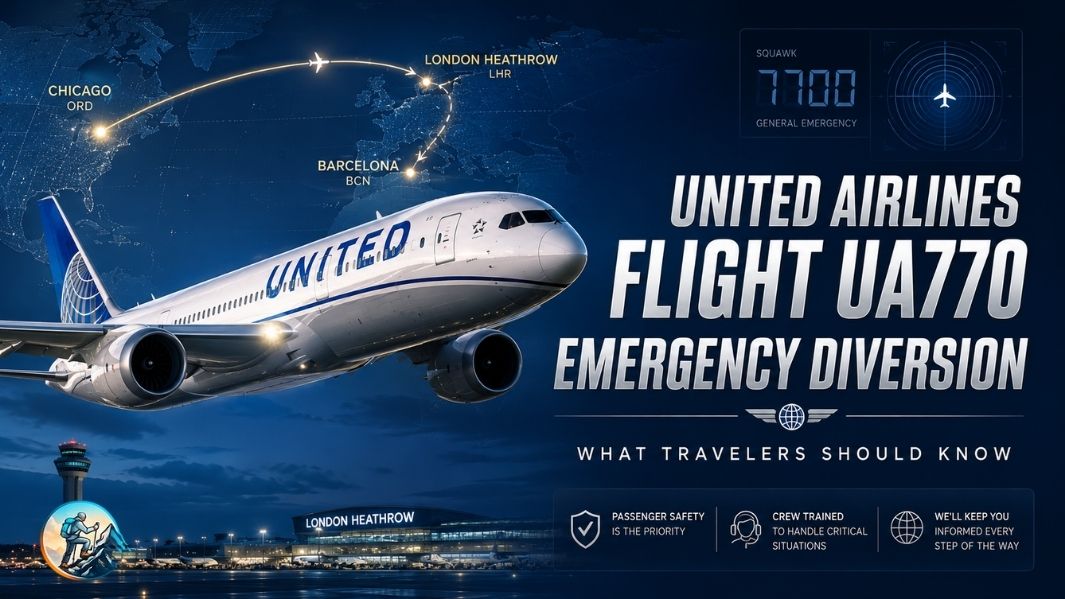
Air travel can turn stressful in seconds when a flight tracker suddenly shows an emergency code or an unexpected airport change. On May 27, 2025, the Barcelona-to-Chicago service declared an emergency while still over Europe and diverted to London Heathrow Airport. The aircraft landed safely, but later online retellings added conflicting claims about the cause, aircraft model, passenger count, and onboard experience. This article separates verified facts from unconfirmed claims while explaining practical steps for travelers today. It explains how an international diversion works, what passengers should expect, and why verified information matters when a routine journey suddenly changes.
What the United Airlines flight UA770 emergency diversion actually involved
UA770 was scheduled to fly from Barcelona El Prat Airport (BCN) to Chicago O’Hare International Airport (ORD). Roughly ninety minutes after departure, the crew selected transponder code 7700, the internationally recognized general-emergency code, and changed course for Heathrow. Contemporary reporting said United confirmed the diversion. The aircraft later landed on Heathrow’s Runway 27R and moved to Gate B44. Registration N26902, linked to the flight, is a Boeing 787-8 Dreamliner. Some later articles described a 787-9 and assigned specific technical failures to the event, but those details are not consistently supported. The safest description is simple: the crew declared an emergency, diverted to London, and landed safely.
Why the United Airlines Flight UA770 emergency diversion matters to travelers
An emergency diversion sounds frightening, but a diversion is a safety action. Pilots may change course due to a technical warning, medical issue, security concern, weather condition, or another condition requiring quicker access to an airport. A squawk 7700 alert tells air traffic control that the aircraft needs priority handling; it does not reveal the exact problem. That distinction matters because flight-tracking screenshots can spread online before an airline explains what happened. As a traveler, I would rather see a crew choose a suitable airport early than continue a long ocean crossing with an unresolved concern. A useful travel rule is, “Calm information beats dramatic speculation.”
What should passengers do after an unexpected diversion?
If your flight diverts, keep your passport, phone, medication, charger, and essential documents with you, not buried in checked baggage. Listen carefully to cabin announcements because crews may not immediately know whether the aircraft will continue, passengers will transfer to another plane, or the journey will end at the diversion airport. Once on the ground, check the airline app for rebooking, connection changes, baggage instructions, and hotel or meal information. Avoid making expensive replacement bookings until you understand what the airline is offering. If you have travel insurance, save boarding passes, delay notices, receipts, and screenshots of the updated itinerary.
How to judge emergency-flight information online
The UA770 story also reminds us that aviation news can quickly become distorted. When reading about an emergency landing, first compare the date, route, aircraft registration, and diversion airport across reliable sources. If several articles give different causes but none quotes an airline, airport, regulator, or established aviation tracker, treat the technical explanation as unconfirmed. Travelers searching after a disruption should focus first on operational facts: where the aircraft landed, whether the flight will continue, how connections are affected, and what assistance is available. Those details are more useful than dramatic theories about what may have happened in the cockpit.
Why Heathrow was a practical diversion point
For a widebody aircraft operating from Spain toward the United States, London Heathrow offers long runways, extensive emergency capability, major-airline ground support, maintenance resources, and numerous onward travel options. The strongest available reporting did not publicly detail why the UA770 crew selected Heathrow, so it would be wrong to invent a technical explanation. Still, choosing a major airport during an emergency can simplify aircraft handling and passenger recovery. For travelers, this means a diversion to a large international hub may create delays and missed connections. Still, it can also provide more practical options for rebooking, accommodation, and onward transport than a smaller airport.
Conclusion
The United Airlines flight UA770 emergency diversion is best understood as a real operational disruption surrounded by later online confusion. The confirmed core is straightforward: UA770 left Barcelona for Chicago on May 27, 2025, declared an emergency, used code 7700, diverted to Heathrow, and landed safely. The exact technical trigger should not be presented as certain without stronger confirmation. For passengers, the bigger lesson is reassuring: diversions are part of aviation’s safety system, not evidence that safety has failed. Stay attentive, keep essential items close, document your disruption, and rely on verified updates. When travel plans suddenly change, good information is one of the most valuable things you can carry.
You May Read Also: Before You Book an Older Stay: Asbestlint and Asbestos Safety for Travelers