

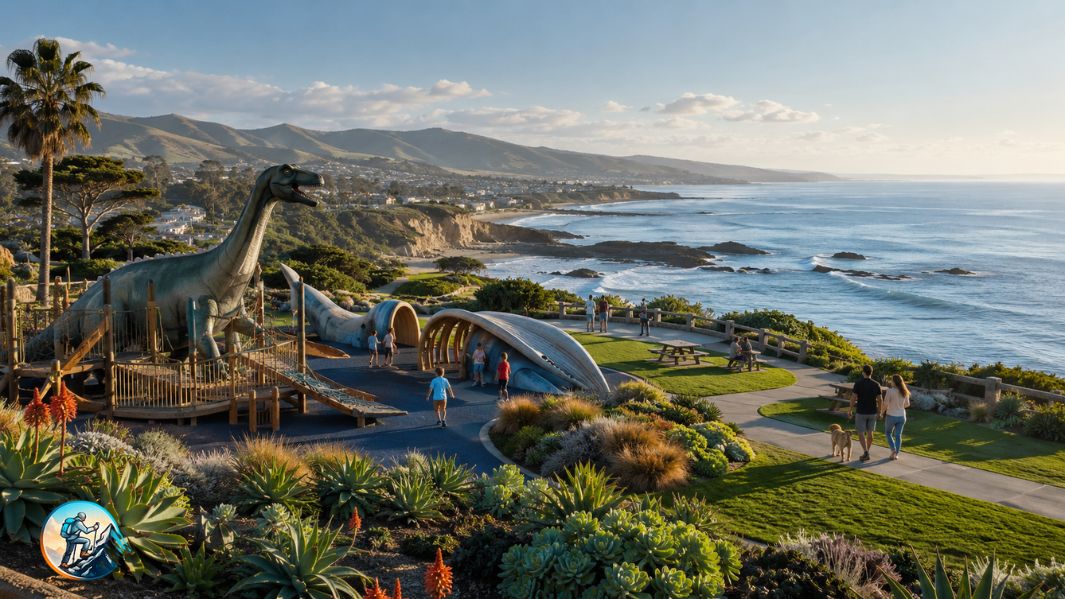
Some coastal parks impress you with scenery, while others keep children entertained. Dinosaur Caves Park manages both without feeling crowded or overly commercial, making it an easy choice for families and road-trippers alike. Set on an 11-acre bluff in the Shell Beach area of Pismo Beach, California, the park combines sweeping Pacific views, open lawns, walking paths, picnic spaces, and a playful dinosaur-and-sea-life theme. It is the kind of stop that works equally well for a road-trip break, a family morning, or a sunset walk.
Why Dinosaur Caves Park Is Worth Visiting
The park’s biggest attraction is its setting, and it is reason enough to visit. Oceanfront bluffs frame views of rocky shoreline, offshore formations, seabirds, and changing coastal light. Photographers often arrive when the sun is low, while walkers and joggers appreciate the easy paths and frequent places to pause. Families can spread a blanket across the grass, enjoy lunch near the playground, and still feel connected to the sea. The official city description also lists an amphitheater, a wedding overlook, restrooms, and off-street parking among the park’s facilities.
Dinosaur Caves Park Playground and Family Experience
The themed playground is more imaginative than a standard neighborhood play area. Children can explore dinosaur eggs, marine-animal sculptures, swings, climbing features, and the USS Imagination play ship. This mix of prehistoric shapes and ocean creatures makes the space especially appealing to younger visitors, while the broad lawns give older children room to run. Parents should choose a bench or picnic table with a clear view of the play zone, because the layout encourages children to move quickly between activities.
My favorite quality is that adults do not have to “endure” the playground visit. The ocean remains visible, the breeze keeps the atmosphere fresh, and the surroundings feel like part of a genuine California Central Coast outing. That is why the park feels like more than a children’s stop; as a simple travel truth says, “The best family stops are the places where nobody feels rushed.”
Best Things to Do at the Park
Begin with a slow walk along the bluff-top trail before the playground becomes the main event. Accessible pathways connect lawns, viewpoints, benches, landscaped areas, the amphitheater, and the play space. Access California describes the main out-and-back bluff route as roughly 1.2 miles long, with generally gentle terrain consisting of pavement and decomposed granite. Some transitions and inclines may require additional care for wheelchair users or anyone with limited mobility.
From the trail, bring binoculars or use your phone’s zoom rather than approaching the cliff edge. Seabirds are commonly visible, and visitors may occasionally spot dolphins or sea lions offshore, although wildlife sightings are never guaranteed. The park is also an excellent place for coastal photography, sketching, reading, or simply listening to the surf. For a picnic, pack food that is easy to secure; wind can rise quickly on exposed bluffs.
Planning a Smooth Visit to Dinosaur Caves Park
The park is located at 2701 Price Street, near the corner of Cliff Street and Shell Beach Road. Drivers approaching on Highway 101 can use the Mattie Road exit from the north or the Price Street exit from the south. Once you arrive, off-street parking and designated accessible spaces are available, though popular weekends and community event days may be busier. Arriving earlier in the morning usually provides a calmer playground, softer light, and easier parking.
Restrooms are near the parking area, and accessibility information lists all-gender facilities with baby-changing stations. Dogs are permitted on leashes, so bring waste bags and keep pets under control around children, picnic areas, and cliffside paths. Coastal weather can shift even on a day; carry a light jacket, sunscreen, water, and a hat with a secure fit.
Is there direct beach access from the park? Visitors should treat this primarily as a bluff-top park, not a swimming beach. Stay behind barriers, supervise children closely, and avoid informal routes down unstable cliffs. Anyone seeking sand or water activities should plan a separate stop at an established beach access point.
The Story Behind the Dinosaur Name
The name does not come from a fossil discovery. Instead, in the 1940s, H. Douglas Brown began building a giant concrete-covered brontosaurus beside a roadside attraction known for its sea caves. Visitors once entered through the dinosaur’s tail to explore the “Caves of Mystery.” The structure remained unfinished, was later removed, and the caves gradually collapsed, but the unusual local story survived in the park’s name and playful design.
A Coastal Stop That Pleases Every Generation
Dinosaur Caves Park succeeds because it offers freedom without demanding a complicated itinerary, giving you a strong reason to stop. Children find adventure in the playground, adults gain breathing room beside the Pacific, and travelers can enjoy a memorable visit without purchasing tickets. Give yourself at least an hour, stay longer for a picnic or sunset, and let the ocean set the pace. On a busy California road trip, that combination of play, history, and open sky can feel wonderfully restorative.
You May Read Also: Beyond Dorset’s Coast: A Quiet Walk Across Steeple Hill