

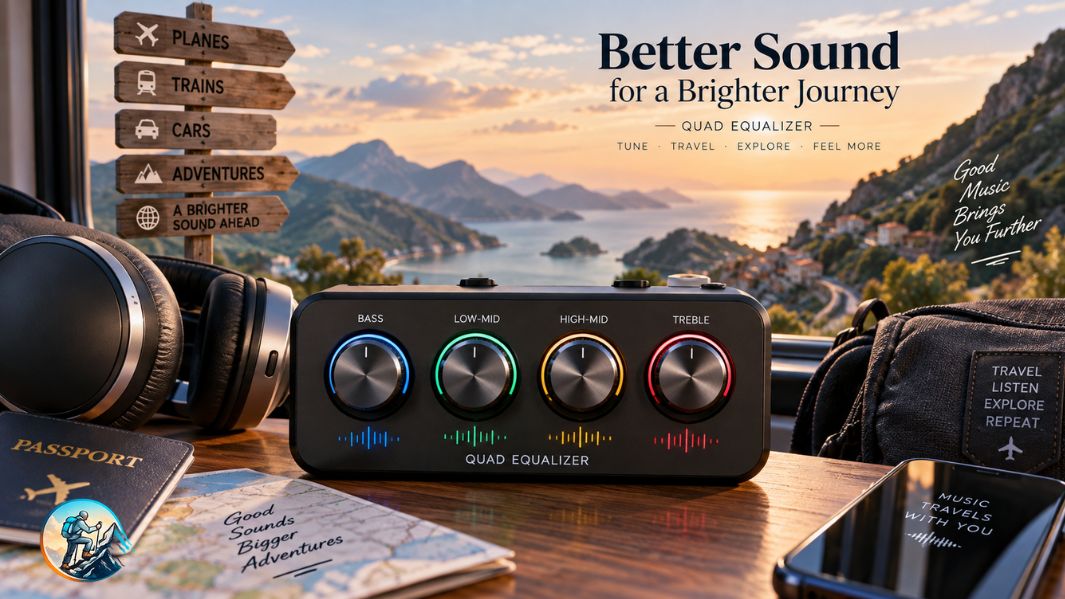
Travel changes the way we hear things. A favorite playlist can sound warm at home, then suddenly feel thin on a train, boomy in a rental car, or harsh through compact travel speakers. That is where a Quad Equalizer can help. In audio contexts, the term commonly describes an equalizer with four adjustable frequency sections, though some equipment uses “quad” for four separate channels. For travelers, the practical idea is simple: four broad controls can help adapt music, podcasts, films, and calls to changing environments.
Travel audio is less about chasing perfect sound and more about making sensible corrections. Airports, buses, hotel rooms, and cars all color sound differently. A simple four-band EQ gives enough control to respond without spending half your trip adjusting sliders.
Why a Quad Equalizer Makes Sense for Travel
A Quad Equalizer generally gives you control over four areas of the sound spectrum, often covering bass, low-mid, high-mid, and treble. Bass adds weight, low-mids influence warmth, high-mids affect presence and speech clarity, and treble shapes brightness and detail.
That matters on the road because your surroundings rarely stay consistent. Road noise can hide detail. Aircraft cabins create a steady background rumble. Small hotel speakers may exaggerate certain frequencies, while headphones can sound different depending on design and fit. Rather than turning the volume up, audio equalization lets you make targeted changes.
Quad Equalizer Settings for Planes, Trains, and Cars
No universal “best” setting exists because headphones, speakers, recordings, and environments vary. Start with all four bands neutral. On a plane, avoid boosting bass aggressively to overpower engine noise. Instead, make modest adjustments and prioritize vocal clarity for podcasts, audiobooks, or films.
On trains, low-frequency rumble may make music muddy. Slightly reducing the lower bands can sometimes clean up the mix. In a rental car, begin with a flat setting. Car cabins are reflective spaces, and exaggerated bass or treble can make a long drive uncomfortable.
My rule is simple: change one band at a time, listen briefly, and stop once the problem disappears. “Better” should mean easier to listen to, not more dramatic.
Using a Quad Equalizer With Travel Headphones
Travel headphones often include an app with preset or manual EQ controls. If a four-band option is available, save a few practical profiles rather than constantly retuning. One profile can favor spoken-word audio, another can suit relaxed music, and a third can remain flat for balanced recordings.
Noise cancellation and EQ solve different problems. Active noise cancellation reduces external noise electronically, while EQ changes the tonal balance of the audio you are playing. Used together, they can make listening more comfortable, but neither is a reason to use unnecessarily high volume.
How Quad Equalizer Tuning Helps With Podcasts and Movies
Speech depends heavily on the midrange. If dialogue sounds buried during a flight or bus journey, increasing overall volume may make music and effects unpleasantly loud. A small adjustment to the mid or upper-mid region may bring voices forward more naturally.
For movies, resist trying to create huge bass through small headphones or speakers. Travel listening often benefits more from balanced sound, understandable dialogue, and controlled treble. If “s” sounds become sharp or cymbals feel piercing, slightly reducing the highest band may help.
A Simple Travel Setup That Actually Works
Keep your setup uncomplicated: comfortable headphones, downloaded media, a charging cable, and an EQ profile you understand. Test your settings before leaving home. Offline playlists and downloaded podcasts are useful where mobile coverage is unreliable.
If you use a portable speaker in accommodation, respect quiet hours and shared spaces. Sound that feels moderate beside you can travel through hotel walls, balconies, campsites, or hostel rooms.
A quote worth remembering is, “The journey is the destination.” Your soundtrack should support that journey, not distract from it.
Common Quad Equalizer Mistakes Travelers Should Avoid
The biggest mistake is extreme boosting. Pushing several bands upward can create harshness, distortion, or encourage higher listening levels. Another mistake is copying somebody else’s “perfect” settings without considering different headphones and hearing preferences.
Also remember that EQ cannot repair poor-quality speakers, damaged headphones, or a badly recorded source. Use it as a fine-tuning tool. Small changes are usually more useful than dramatic curves.
Final Thoughts
A Quad Equalizer can be a practical travel companion when you treat it as a sound-shaping tool rather than a technical puzzle. Start flat, identify what bothers you, adjust one frequency area gently, and keep listening levels comfortable. Whether you are crossing a city by train, settling into a long flight, or unwinding in a hotel after exploring, thoughtful EQ settings can make audio clearer, calmer, and better suited to the moment.
You May Read Also: From Boardrooms to Boarding Gates: Why Peter Orszag Hair Became an Unusual Travel Search