

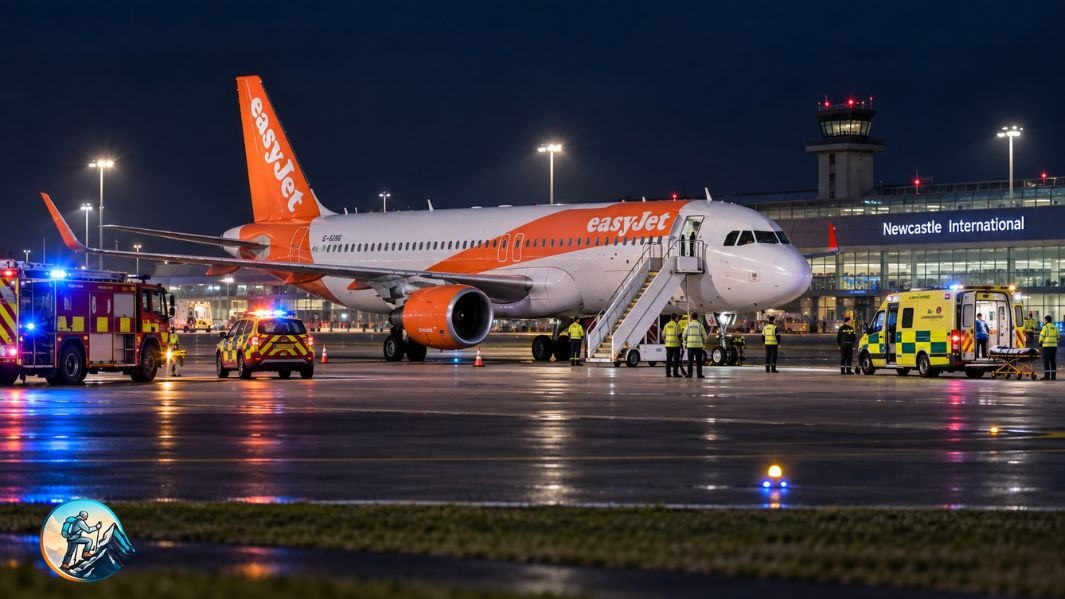
A routine journey became an unexpected diversion on October 27, 2025, when an easyJet flight from Copenhagen to Manchester changed course and landed in Newcastle. The event is widely searched as “EasyJet Flight U2238 Emergency Landing Newcastle,” but travelers should know: the aircraft involved was actually operating as U22238, also identified as EZY2238. The diversion stemmed from a passenger welfare issue rather than a confirmed mechanical failure, and the aircraft landed safely before later continuing to Manchester.
For travelers, stories like this can sound frightening because the words emergency landing often suggest an aircraft problem. In this case, available reporting points to an onboard medical emergency. The crew diverted to get a passenger appropriate help quickly. An emergency declaration is a safety tool, not proof that an aircraft is in immediate danger.
EasyJet Flight U2238 Emergency Landing Newcastle: What Happened
The Copenhagen to Manchester flight departed on October 27 aboard an Airbus A320. While crossing the North Sea, the crew declared an emergency and selected transponder code 7700, which signals an emergency to air traffic control. The flight then diverted toward Newcastle International Airport, where medical assistance could be arranged.
The aircraft landed safely at Newcastle at 10:52 p.m. GMT. Paramedics attended to the passenger after arrival, and the aircraft remained on the ground before resuming its journey. It later reached Manchester Airport shortly after midnight on October 28. Reliable reporting indicates no crash, engine failure, fire, or loss of aircraft control.
EasyJet Flight U2238 Emergency Landing Newcastle: Why the Number Is Confusing
The flight-number issue is important. EasyJet’s IATA airline code is U2, so flight number 2238 can appear commercially as U22238 when written without a space. Aviation tracking may display the same service as EZY2238. By contrast, U2238 means U2 flight 238, a different service operating between Newcastle and Bristol.
That explains why readers may find conflicting articles. If you are researching the Newcastle diversion, U22238 or EZY2238 is the more precise identifier. Using the correct number helps separate the real incident from unrelated flight history.
Why Newcastle Was a Practical Diversion Airport
When a passenger needs urgent medical attention, pilots do not simply continue to the planned destination. They consider the seriousness of the situation, nearby suitable airports, runway availability, air traffic, weather, ground medical support, and the time required to land safely.
Newcastle offered a suitable place to bring the aircraft down and transfer responsibility to medical professionals. That is what a flight diversion is designed to achieve: reduce risk by getting the aircraft and the person needing help to a practical location.
As a traveler, I would rather arrive late than watch a crew ignore a serious health problem to protect the timetable. A useful travel thought is, “A diversion changes the journey, not the destination.”
What Passengers Should Do During an In-Flight Diversion
If your flight suddenly changes course, keep your seat belt fastened, listen to cabin crew instructions, and avoid relying on dramatic social-media posts before the airline explains what happened. Flight-tracking apps can show route changes and emergency codes, but they do not always reveal the reason.
Keep essential medication, identification, a charging cable, and valuables in your cabin bag, not checked luggage. If the diversion causes a long delay, save boarding passes, receipts, airline messages, and screenshots of official updates. Those records can help when asking the airline about rebooking, assistance, expenses, or passenger rights.
Remember that Squawk 7700 is a general emergency signal. It does not independently mean an engine has failed or a crash is imminent. Context matters.
What the Newcastle Diversion Tells Travelers About Aviation Safety
The strongest lesson from this incident is not that flying suddenly became dangerous. It is that commercial aviation has procedures for unpredictable situations, including passenger illness. Pilots can declare an emergency, air traffic control can prioritize the flight, airports can prepare emergency services, and cabin crews can manage passengers while plans change.
For nervous flyers, that may be the most reassuring part of the story. The system is designed to create options when something unexpected happens.
Final Thoughts
The story commonly described as the EasyJet Flight U2238 Emergency Landing Newcastle was a real diversion, but the accurate flight identifier was U22238/EZY2238. The October 27, 2025 Copenhagen-to-Manchester service diverted to Newcastle because of a reported passenger welfare issue, landed safely, and later continued to Manchester.
For travelers, the practical takeaway is simple: an emergency diversion does not automatically mean an aircraft failure. Sometimes it means the crew is making the safest possible decision for one person onboard. Staying calm, following instructions, keeping travel essentials accessible, and waiting for verified information can make a diversion easier to handle.
You May Read Also: From Frankfurt to Caribbean Shores: Fraboc Travel Guide for a Smarter Island Journey