
Blog
Incfidelibus Explained: The Surprising Truth About Its Meaning, Origin, and Latin Roots

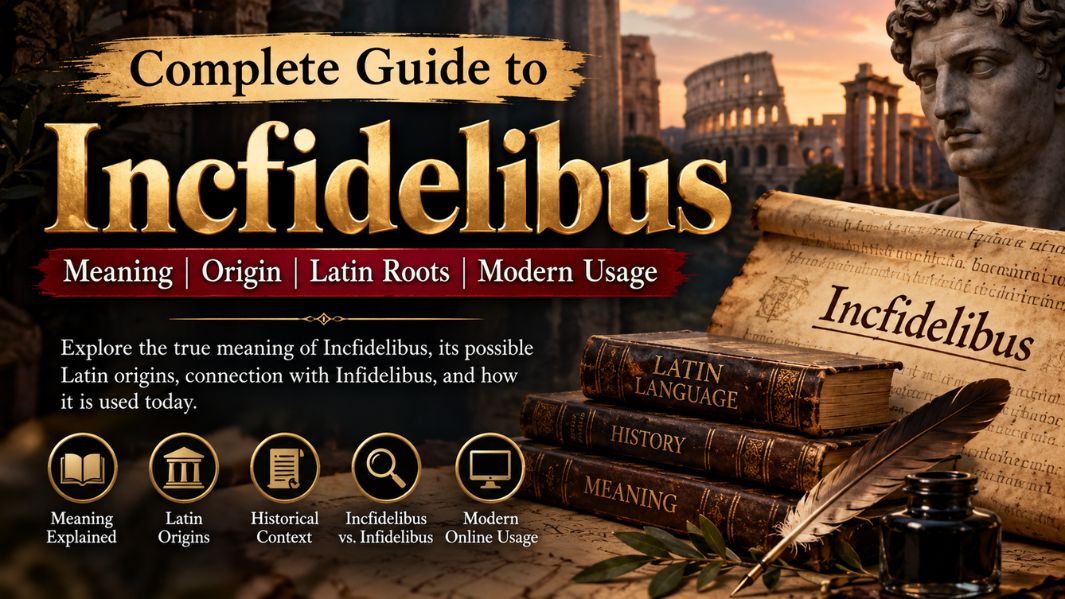
Incfidelibus is an unusual term that has drawn curiosity because of its mysterious appearance and apparent connection to Latin. At first glance, it resembles an ancient expression associated with faith, loyalty, belief, and trust. However, understanding its actual meaning requires separating linguistic evidence from modern interpretations. Unlike established Latin vocabulary, Incfidelibus lacks a clearly verified, independent dictionary definition. Its closest recognized counterpart is infidelibus, a grammatical form connected to the Latin adjective infidelis. This distinction is important because a small spelling difference can significantly affect whether a term is historically authentic or simply a modern variation. Exploring the origins, grammar, historical associations, and online appearances of Incfidelibus clarifies why this unfamiliar expression continues to raise questions.
What Is Incfidelibus?
Incfidelibus is best understood as a nonstandard Latin-looking expression whose precise origin has not been conclusively established. Although it appears structurally similar to genuine Latin vocabulary, major traditional Latin references do not recognize the spelling as an independent word. The closest documented form, infidelibus, belongs to a linguistic family associated with loyalty, trustworthiness, and religious belief. This resemblance helps explain why people sometimes interpret Incfidelibus as a historical word for unfaithfulness or disbelief. However, assigning those meanings directly to the unusual spelling would be misleading. The expression could represent a typographical mistake, an inaccurate transcription, or an intentionally created modern name. Determining which explanation applies depends on where the term appears and whether you can identify its original context.
The Meaning of Incfidelibus Explained
The most important fact about Incfidelibus meaning is that no securely established standalone Latin definition has been verified. Instead, the meanings commonly associated with it originate from the legitimate Latin adjective infidelis. This adjective can describe someone or something considered unfaithful, unreliable, disloyal, or lacking religious belief. Its interpretation depends heavily on the surrounding language and historical situation. For instance, a reference to unfaithful political allies conveys a different idea from a religious discussion about unbelief. These distinctions demonstrate why translating a Latin expression requires more than identifying a familiar root. When Incfidelibus appears without further explanation, it is more accurate to describe its connection to existing Latin vocabulary than to present a definitive translation that historical evidence does not support.
The Latin Origins and Linguistic Background
Understanding the possible linguistic background of Incfidelibus begins with the Latin noun fides, which expresses concepts such as faith, confidence, reliability, and trust. From this broader linguistic family comes fidelis, an adjective meaning faithful, loyal, or trustworthy. The negative prefix in- creates infidelis, describing the opposite qualities, including unfaithfulness or unreliability. The recognized grammatical form infidelibus develops through normal Latin adjective inflection. It is the dative or ablative plural form of infidelis, applicable across grammatical genders. The extra letter c in Incfidelibus does not belong to that established grammatical formation. There is no demonstrated Latin rule that requires inserting this letter between the negative prefix and the remaining word. Consequently, the resemblance provides a plausible explanation for the term’s appearance without proving that the unusual spelling originated in antiquity.
Incfidelibus vs. Infidelibus: Understanding the Difference
The difference between Incfidelibus and infidelibus may appear insignificant because only one additional letter separates them. Linguistically, however, that letter determines whether the spelling matches a recognized Latin form. Infidelibus is a legitimate grammatical construction that established Latin dictionaries and declension patterns can confirm. Incfidelibus, by comparison, remains a nonstandard spelling without a confirmed independent historical meaning. Latin grammar relies on precise word endings to express relationships between words, including whether something is being given to someone or occurs with or through someone. The ending -ibus has an identifiable grammatical function, but the inserted c does not contribute a recognized meaning. Readers should therefore avoid treating the two spellings as interchangeable when discussing historical documents, academic translations, or linguistic research.
How Latin Grammar Helps Explain the Confusion
Latin differs from modern English because grammatical endings carry information that English frequently communicates through prepositions and word order. The dative case can express an indirect object or recipient, while the ablative case performs several functions involving circumstances, means, separation, and relationships expressed through prepositions. In infidelibus, the ending can support translations such as “to the unfaithful,” “for the unbelieving,” or “with the unfaithful,” depending on the full sentence. These are contextual interpretations, not universal definitions. An isolated Latin word often cannot be translated accurately without examining the surrounding grammar. This is especially true when readers encounter Incfidelibus in search results or unfamiliar documents, where the lack of a complete sentence makes unsupported interpretations tempting.
Is Incfidelibus an Ancient Latin Word?
Currently, there is insufficient evidence to identify Incfidelibus as a recognized ancient Latin term. Established Latin references document the related adjective infidelis and its conventional grammatical forms, but they do not establish the extra-c spelling as a standard independent expression. This does not automatically reveal when or where the unusual spelling first appeared. Historical documents sometimes contain regional spelling differences, copying errors, and unusual constructions that require specialized analysis. Nevertheless, a word should not be described as ancient merely because it resembles Latin or appears on a website discussing historical language. Strong historical claims require identifiable manuscript evidence, trustworthy textual editions, or scholarly linguistic documentation. Until such evidence establishes a distinct historical usage, Incfidelibus should be treated as an uncertain spelling rather than an authenticated expression from classical or medieval Latin.
Possible Reasons Behind the Unusual Spelling
Several explanations could account for the appearance of Incfidelibus, although none has been conclusively established as its single source. One possibility is a straightforward typing error in which an extra letter was inserted into the genuine form infidelibus. Another possibility is transcription errors when copying unfamiliar words from manuscripts or printed materials. Historical documents can be particularly difficult to reproduce because their lettering, abbreviations, and writing conventions differ from contemporary standards. Another possibility is optical character recognition (OCR), the technology that converts scanned text into searchable digital content. OCR systems sometimes misidentify letters, especially in deteriorated documents or unusual typefaces. Finally, someone may have deliberately selected Incfidelibus as a distinctive username, project title, or online identity. These possibilities explain how the spelling could exist, but they do not prove a specific origin.
Historical Connections With Faith and Loyalty
The Latin vocabulary surrounding infidelibus reflects concepts that mattered in Roman political life and later religious traditions. In classical contexts, fides could describe trust between individuals, obligations between communities, or reliability in agreements. Loyalty was especially significant in discussions of alliances, political relationships, and personal conduct. The adjective infidelis could therefore criticize someone considered unreliable or unfaithful to an obligation. In later Christian Latin, the same word family also developed religious applications concerning belief and unbelief. These historical meanings are documented in Latin vocabulary and help explain why Incfidelibus appears connected to faith-related ideas. However, there is no sound basis for presenting Incfidelibus itself as the official name of an ancient philosophical doctrine, religious movement, or historical tradition.
Why Incfidelibus Appears in Online Searches
Uncommon expressions often attract attention because readers want to understand words they cannot easily find in familiar dictionaries. Incfidelibus fits this pattern because its appearance suggests an identifiable meaning while offering little immediate explanation. Once an unusual spelling becomes searchable, websites may publish interpretations, discussions, or speculative descriptions addressing the same question. Search engines can then display multiple pages repeating similar information, creating the impression that the expression has a long-established history. However, online repetition is not the same as independent verification. Several articles may ultimately rely on the same assumption rather than separate historical evidence. This distinction matters especially when a word is described with attractive but unsupported concepts such as personal transformation, spiritual awakening, or hidden ancient wisdom. Such interpretations may work as creative symbolism, but they should not be represented as confirmed translations.
Incfidelibus in Modern Digital Communication
Outside historical linguistics, Incfidelibus may function as an online identifier or invented name. The internet allows people to create usernames, project labels, and distinctive expressions without following traditional spelling conventions. A word inspired by Latin can become recognizable within a particular community even when it has no established dictionary meaning. Some online discussions have also linked similar unusual identifiers to messages that claim account access or digital monitoring. However, the spelling alone does not establish that a message is fraudulent, nor does it identify a specific legitimate service or organization. If you encounter Incfidelibus in an unexpected email, message, or on a website, examine the sender, context, and requested actions. The surrounding evidence is more informative than the unfamiliar word itself.
How to Identify Reliable Information About Incfidelibus
Effective research on Incfidelibus requires distinguishing verifiable linguistic evidence from speculation. A useful starting point is a recognized Latin dictionary containing historical examples and grammatical descriptions. Readers can compare the spelling with infidelis, examine how the adjective changes across grammatical cases, and determine whether the unfamiliar variation appears in authenticated historical material. When a website claims that Incfidelibus represents an ancient belief system or a specific philosophical principle, it should support that claim with identifiable original texts rather than repeated explanations from unrelated websites. It is also important to distinguish a linguistic definition from the personal meaning that someone may attach to a modern name. A creator may use an invented term symbolically, but that modern interpretation does not establish an ancient etymology. Careful verification produces a more useful answer than an elaborate explanation built on uncertain assumptions.
The Difference Between Literal Meaning and Modern Interpretation
One reason Incfidelibus can be confusing is the difference between literal linguistic meaning and symbolic interpretation. A literal translation depends on documented vocabulary, grammar, and historical usage. A symbolic interpretation, however, may depend on an individual’s or community’s intentions. Someone might associate an invented Latin-looking name with trust, betrayal, skepticism, or personal identity because those themes resemble the meanings of related Latin words. Such associations are possible creative choices, but they do not automatically become accepted dictionary definitions. This distinction helps when evaluating unusual names in literature, social media, or digital projects. Understanding the distinction helps readers appreciate creative language without confusing personal symbolism with established historical evidence.
Why Accurate Spelling Matters in Historical Research
Precise spelling is especially important when studying older languages because even small differences can affect grammatical identification and translation. In English, readers can often infer the intended meaning of a misspelled word from context. Latin presents additional challenges because ending changes often indicate different grammatical roles. An incorrectly inserted letter may prevent a word from matching a known dictionary entry or confuse its structure. Incfidelibus shows how a seemingly minor variation can prompt extensive speculation about meaning and origin. Accurate transcription, reliable dictionaries, and contextual analysis are therefore essential when interpreting unfamiliar historical vocabulary. Rather than treating uncertainty as a weakness, recognizing what remains unverified helps maintain a clearer distinction between linguistic scholarship and imaginative explanation.
Conclusion
Incfidelibus is an intriguing example of how an unfamiliar spelling can generate curiosity about language, history, and meaning. Although it closely resembles the genuine Latin form infidelibus, the available evidence does not establish it as a separate historical word with a verified definition. Its connection to the Latin vocabulary of faith, loyalty, trust, and unbelief explains many online interpretations, but those interpretations must be distinguished from documented linguistic facts. The unusual spelling may have developed through an error or deliberate modern usage, although its exact origin remains unresolved. Ultimately, understanding Incfidelibus requires attention to grammar, historical evidence, and context rather than speculation. This approach offers a clearer, more reliable explanation of a term that initially seems more mysterious than the available evidence supports.
(FAQs)
1. What does Incfidelibus mean?
Incfidelibus does not have a confirmed independent definition in standard Latin. It closely resembles infidelibus, a recognized form associated with unfaithfulness, disloyalty, unreliability, or unbelief, depending on context.
2. Is Incfidelibus a real Latin word?
The exact spelling Incfidelibus is not established as a standard Latin word in commonly recognized references. Infidelibus, without the additional letter c, is the documented grammatical form.
3. Where did Incfidelibus originate?
Its precise origin remains uncertain. Possible explanations include a spelling mistake, a transcription error, a digital text-recognition issue, or a deliberately created online name. None has been conclusively demonstrated as the source.
4. Does Incfidelibus have a religious meaning?
The related Latin adjective infidelis has religious uses associated with unbelief, particularly in ecclesiastical Latin. However, this does not make Incfidelibus an authentic religious expression.
5. Why are people searching for Incfidelibus?
People may encounter the unusual spelling in online content, unfamiliar documents, or digital communications. Its resemblance to Latin vocabulary naturally encourages questions about its meaning, history, and authenticity.

John Playfair: The Remarkable Life of Prue Leith’s Husband and Former Fashion Designer

thealitekeepsafe.com: A Complete Guide to Its Features, Online Safety, Content, and Trustworthiness

Growth Navigate Funding: A Complete Guide to Smart Business Financing and Sustainable Growth

Almawadahit. com Explained: A Complete Guide to Its Content, Features, and Online Reputation

UK Supermarket Fruit Salmonella Recall: Major Safety Warning That Affected Six Leading Retailers

Tracey Knievel: The Remarkable Untold Story of Evel Knievel’s Daughter and Her Life Beyond Fame

Jeremy Yaffe: The Remarkable Untold Story of Alan Arkin’s First Wife and Her Life Beyond Hollywood

Solica Casuto: The Fascinating Story of Andy Griffith’s Second Wife and Her Private Life

Tara Beane: The Remarkable Family Story Behind Billy Beane’s Moneyball Legacy

Wendy Etris: The Inspiring Story of AJ Styles’ Wife, Marriage, Children and Private Life

Everest Base Camp Trek vs Manaslu Circuit Trek: Routes, Difficulty, Costs, Altitude and Mountain Experience

Crackstube Explained: A Complete Guide to Its Features, Content, Safety, and Digital Publishing Platform

ABS Testauslösung: Bedeutung, Funktion, häufige Fehler und wichtige Sicherheitstipps

Classroom 15x: The Ultimate Guide to Free Online Games, Features, Benefits, and Safe Gaming

Nomurano: Discover the Powerful Meaning Behind Modern Creativity, Design, and Intentional Living

HMJones.net Explained: A Complete Guide to Business Loans, Funding Options, and Smarter Financial Decisions

Nigel Mackintosh: The Remarkable Business Career, Family Heritage and Life of Millie Mackintosh’s Father

Provascin: A Complete Guide to Its Ingredients, Potential Benefits, Uses, and Safety

Ruschek: The Fascinating History, Meaning, Origins and Legacy of a Rare European Surname

Mindset Energy: The Powerful Secret to Better Focus, Confidence, and Personal Growth
John Playfair: The Remarkable Life of Prue Leith’s Husband and Former Fashion Designer
thealitekeepsafe.com: A Complete Guide to Its Features, Online Safety, Content, and Trustworthiness
Growth Navigate Funding: A Complete Guide to Smart Business Financing and Sustainable Growth
Almawadahit. com Explained: A Complete Guide to Its Content, Features, and Online Reputation
UK Supermarket Fruit Salmonella Recall: Major Safety Warning That Affected Six Leading Retailers
Tracey Knievel: The Remarkable Untold Story of Evel Knievel’s Daughter and Her Life Beyond Fame
Jeremy Yaffe: The Remarkable Untold Story of Alan Arkin’s First Wife and Her Life Beyond Hollywood
Solica Casuto: The Fascinating Story of Andy Griffith’s Second Wife and Her Private Life
Tara Beane: The Remarkable Family Story Behind Billy Beane’s Moneyball Legacy
Wendy Etris: The Inspiring Story of AJ Styles’ Wife, Marriage, Children and Private Life
-
 Blog3 months ago
Beyond the Cages: How an Artificial Zoo Could Redefine Wildlife Travel
-
Adventure Travel2 weeks ago
Everest Base Camp Trek vs Manaslu Circuit Trek: Routes, Difficulty, Costs, Altitude and Mountain Experience
-
 Destination Guides3 months ago
Beyond the Map: Discovering Haslhof in Italy and Bavaria
-
Technology6 days ago
Crackstube Explained: A Complete Guide to Its Features, Content, Safety, and Digital Publishing Platform