

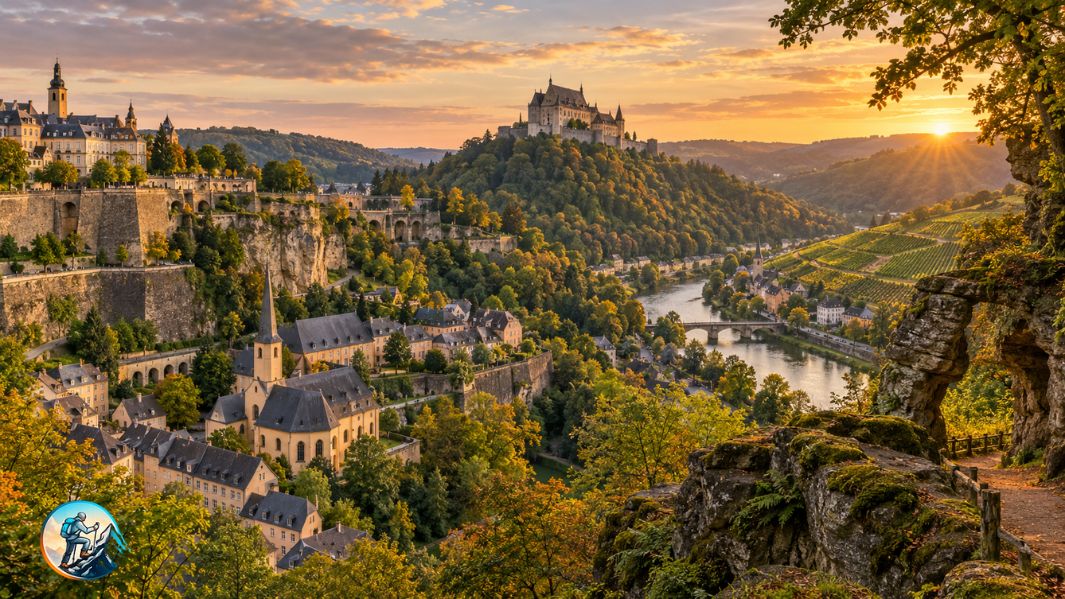
Luxembourg is easy to underestimate. On a European map, the country appears tiny beside France, Germany, and Belgium, yet travelling through it reveals medieval fortifications, wooded ravines, hilltop castles, vineyards, and remarkably peaceful towns. The real advantage is distance: you can wake up among the historic streets of the capital, hike through sandstone formations after lunch, and end the day beside a river beneath a castle.
For travellers who want variety without spending half their holiday moving between destinations, Luxembourg feels refreshingly manageable. Nationwide public transport also makes exploring particularly convenient, with free travel available across much of the country’s public transport network.
Best Places to Visit in Luxembourg for Culture, Castles, and Nature
Luxembourg City: History Above the Gorges
Start with Luxembourg City, where dramatic geography gives the capital far more character than its modest size suggests. The historic quarters and old fortifications form a UNESCO-listed area, while the Bock Casemates, deep valleys, bridges, and the charming Grund district make walking here genuinely memorable.
I would give the capital at least one full day, rather than treating it as a simple arrival point. Wander without rushing, stop at viewpoints above the Alzette valley, and allow time for cafés and smaller streets away from the busiest landmarks.
Vianden: A Fairytale Castle Town
If one place delivers the classic Luxembourg postcard, it is Vianden. The enormous castle rises above the River Our and a compact old town of narrow streets and traditional buildings. Restored Vianden Castle is one of the country’s standout heritage attractions, while surrounding walking routes provide beautiful views across the valley.
Vianden works especially well as a day trip, although staying overnight lets you experience the town once the daytime visitors have disappeared. Photographers should make time for riverside viewpoints and the higher paths around the castle.
Mullerthal: Luxembourg’s Wild Side
Travellers who assume Luxembourg is mainly castles and cities are usually surprised by Mullerthal, commonly called Luxembourg’s Little Switzerland. Dense woodland, sandstone cliffs, narrow ravines, streams, caves, and unusual rock formations create one of the country’s finest outdoor landscapes.
The famous Mullerthal Trail stretches for roughly 112 kilometres, but you don’t need to walk the entire route. Short sections can provide a satisfying taste of the region, including paths around the photogenic Schiessentümpel waterfall.
Echternach: History with a Relaxed Pace
Nearby Echternach makes an excellent companion to a Mullerthal trip. It is the region’s cultural and historical centre and offers a calmer atmosphere than Luxembourg City.
Spend some time walking through the centre before heading into the surrounding countryside. It is particularly appealing to travellers who prefer to combine historic architecture, local atmosphere, and nature rather than rushing between famous attractions.
Moselle Valley and Schengen: Vineyards and European Heritage
Eastern Luxembourg changes the mood again. Vineyards, riverside landscapes, cycling routes, walking trails, and wine-producing villages characterise the Moselle Valley. Schengen adds historical significance because the village became closely associated with Europe’s open internal-border system.
Even travellers who are not interested in wine can enjoy the valley for its scenery and slower rhythm.
Clervaux: Peaceful Northern Escape
For a quieter experience, head into Luxembourg’s northern Éislek region, where wooded hills, steep valleys, castles, and small communities replace the capital’s urban energy. Clervaux is a great base for travellers seeking scenery, history, and a peaceful overnight stop.
Practical Tips for Exploring Luxembourg
How to Plan the Best Places to Visit in Luxembourg
Three to four days can comfortably cover the major highlights. Spend your first day in Luxembourg City, dedicate another to Vianden, and use a third for Mullerthal and Echternach. Add the Moselle Valley or northern Luxembourg if you have an extra day.
Spring and early autumn are particularly appealing for walking, while summer provides longer daylight for countryside trips. Comfortable shoes matter because many of Luxembourg’s best experiences involve hills, cobbled streets, woodland paths, and viewpoints.
A travel rule I often remember is: “The size of a destination says nothing about the size of the experience.” Luxembourg proves it wonderfully.
Conclusion
The best places to visit in Luxembourg work because they offer genuine contrast within remarkably short distances. You can explore ancient fortifications, stand beneath a medieval castle, disappear into a rocky forest, and relax beside vineyard-covered hills during one compact journey.
Don’t visit Luxembourg merely because it fits conveniently between larger European destinations. Give it enough time to reveal itself. The country’s greatest charm is discovering how much history, landscape, and personality fit into such a small corner of Europe.
You May Read Also: From Riviera Blues to Alpine Peaks: Best Places to Visit in Albania