
Blog
Orchid Mantis: The Fascinating Flower-Like Predator With Extraordinary Survival Skills

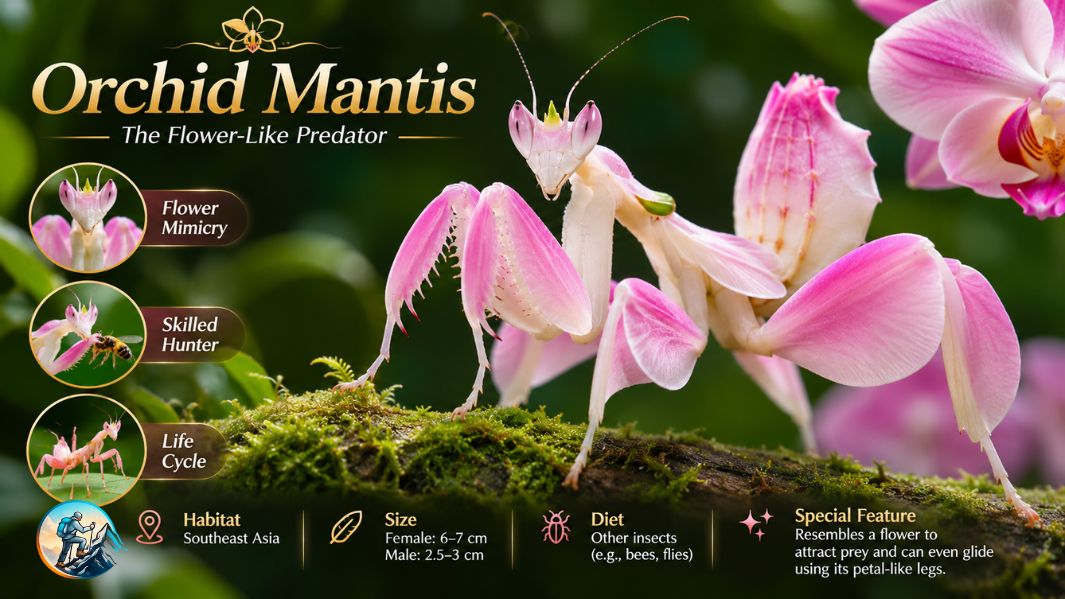
The orchid mantis is one of nature’s most extraordinary insects, combining the delicate appearance of a tropical flower with the hunting abilities of a skilled predator. Scientifically known as Hymenopus coronatus, this remarkable praying mantis is famous for its pale pink and white coloration, petal-shaped legs, and impressive ability to deceive other insects. Although its beautiful appearance suggests a harmless flower, the orchid mantis is a carnivorous hunter that captures unsuspecting prey with remarkable precision. Found primarily in tropical regions of Southeast Asia, it is an exceptional example of adaptation, showing how physical appearance, behavior, and evolution can work together to support survival.
This article explores the orchid mantis, including its distinctive appearance, natural habitat, feeding behavior, reproductive cycle, scientific significance, and unusual adaptations.
What Is an Orchid Mantis?
The orchid mantis is a praying mantis species in the family Hymenopodidae. Its scientific name, Hymenopus coronatus, identifies an insect renowned for its resemblance to flowering plants. Unlike ordinary green or brown praying mantises, this species often shows soft white, pink, and occasionally yellowish or brown coloration that creates a floral appearance. Its specialized body structure includes enlarged sections on the middle and hind legs that resemble flower petals. These features make the insect difficult to recognize as a predator, especially when it remains motionless among tropical vegetation. Despite its delicate appearance, the orchid mantis possesses powerful front legs equipped with spines for capturing prey. Its combination of beauty and predatory efficiency has attracted considerable attention from entomologists, wildlife photographers, and researchers studying animal mimicry.
Physical Appearance and Unique Characteristics
The orchid mantis’s most recognizable feature is its unusual, flower-like body. Its abdomen, legs, and coloration create an appearance that resembles a delicate blossom rather than a typical insect. The enlarged lobes on its middle and hind legs contribute significantly to this effect, while its triangular head, prominent compound eyes, and specialized grasping forelegs reveal its identity as a mantis. Individuals may display different shades throughout their development, with pale white and pink being particularly familiar. The insect’s color is not necessarily permanent, because pigmentation can change gradually as it grows and molts. Unlike animals that rapidly change color, the orchid mantis generally requires time to develop noticeable differences in appearance. Its body structure serves several biological purposes, including visual deception and movement through vegetation. Scientific investigations have also revealed that its petal-like leg extensions contribute to aerial gliding, making these structures more versatile than their appearance initially suggests.
Natural Habitat and Geographic Distribution
The orchid mantis inhabits tropical environments across parts of Southeast Asia, particularly in countries such as Malaysia, Indonesia, and Thailand. Its natural surroundings include humid forests, dense vegetation, and areas containing flowering plants and numerous small insects. These environments provide suitable conditions for hunting, shelter, and reproduction. Although its common name suggests the species lives exclusively on orchids, this is incorrect. Researchers have observed that orchid mantises do not depend on any particular orchid species or flowering plant. They can occupy leaves, branches, and other surfaces within vegetation where their appearance attracts flying insects. Tropical humidity and warmth support their development, while abundant insects provide regular hunting opportunities. Their ability to resemble flowers without staying attached to actual blossoms is a key part of their ecological strategy.
How Orchid Mantis Camouflage Works
One of the most fascinating aspects of the orchid mantis is its ability to deceive insects through aggressive mimicry. Ordinary camouflage often helps an animal avoid predators, but aggressive mimicry can help a hunter attract prey. The orchid mantis uses its flower-like appearance to lure pollinating insects closer. Bees and other flower-visiting insects may interpret its coloration as a possible food source. Scientific research published in The American Naturalist in 2014 demonstrated that orchid mantises could attract wild pollinators even when positioned away from actual flowers. In the experiment, isolated mantises attracted pollinators at a higher rate than the flowers used for comparison. This finding established that the insect’s appearance does more than conceal it among vegetation. Its visual characteristics can actively influence the behavior of potential prey, turning an apparently harmless floral shape into an effective hunting advantage.
Does the Orchid Mantis Really Look Like an Orchid?
Although its name strongly associates it with orchids, the orchid mantis does not perfectly imitate any one flower species. Research examining its shape and coloration found that its appearance falls within the general visual characteristics of multiple flowering plants rather than matching a single botanical model. This distinction matters because pollinating insects often respond to broad visual signals such as color, brightness, and floral shapes. By resembling a generalized flower, the orchid mantis can potentially attract insects without requiring a specific type of blossom nearby. Its appearance is therefore more accurately described as generalized floral mimicry. This strategy illustrates how evolution can produce a useful resemblance without creating an exact copy of another organism.
Hunting Techniques and Feeding Behavior
The orchid mantis is an ambush predator that depends on patience, positioning, and rapid movement to capture prey. Rather than continuously chasing insects, it often stays still while waiting for potential prey to approach. When a suitable insect enters striking distance, the mantis rapidly extends its specialized front legs and seizes the target. These legs contain strong gripping structures and spines that help prevent captured insects from escaping. Its natural prey includes various flying insects, particularly flower visitors such as bees, flies, and other appropriately sized insects. Like other praying mantises, it uses its mouthparts to consume captured prey. This hunting system is efficient because it combines visual deception with a fast, precise attack. The orchid mantis demonstrates that successful predation does not always require speed across long distances; sometimes, attracting prey to a carefully selected position is more effective.
Male and Female Orchid Mantis Differences
One of the most remarkable biological characteristics of this species is its extreme sexual size dimorphism, meaning that adult females and males differ considerably in size. Female orchid mantises commonly reach approximately 6–7 centimeters in length, while adult males are usually around 2.5–3 centimeters. The female’s larger body and more prominent petal-like structures create a particularly striking appearance. Males are relatively slender, lighter, and better suited to movement while searching for mates. Research links these differences to contrasting reproductive and ecological pressures. Larger females can capture substantial prey, while smaller males benefit from mobility. Females also undergo more molts before reaching adulthood, helping explain their significantly greater size. These differences make the orchid mantis an important subject for scientists investigating the evolutionary relationship between body size, hunting success, and reproductive behavior.
Orchid Mantis Life Cycle and Reproduction
The orchid mantis life cycle follows incomplete metamorphosis, which involves three main stages: egg, nymph, and adult. After mating, a female produces eggs enclosed within a protective structure called an ootheca. This egg case helps protect developing offspring until they hatch. Newly emerged nymphs are small and initially look quite different from the familiar pink-and-white orchid mantis. Early-stage young can display striking reddish and black coloration, which researchers have associated with resemblance to warning-colored insects. As development continues, their coloration changes, and the flower-like appearance becomes increasingly recognizable. Because mantises have an external skeleton, growing individuals must periodically shed it through a process called molting. Each molt lets the insect grow and develop more mature characteristics. Eventually, the final molt produces an adult with fully developed reproductive structures. Environmental conditions, food availability, and sex influence the speed of development and overall lifespan.
Scientific Discovery: Orchid Mantises Can Glide
A particularly interesting discovery has expanded scientific understanding of the orchid mantis beyond its famous floral appearance. Research published in Current Biology in 2024 demonstrated that wingless orchid mantis nymphs can glide through the air using their enlarged, petal-like leg structures. These extensions function as aerodynamic surfaces that help slow and control descent. During experiments, researchers observed that the nymphs could maintain controlled gliding movements after being released from an elevated position. The leg lobes increased the insects’ effective surface area, making aerial movement more efficient. When researchers experimentally reduced these structures, gliding performance declined. This discovery revealed that the same anatomical features associated with floral appearance also provide advantages during movement. It highlights an important principle of evolutionary biology: a physical structure can serve several functions, including hunting, protection, and locomotion.
Predators and Natural Survival Challenges
Despite its impressive hunting ability, the orchid mantis faces threats from larger animals and environmental conditions. Insect-eating birds, reptiles, and other predators can potentially capture mantises when opportunities arise. Its flower-like appearance may reduce detection in some cases, but its effectiveness depends on the predator and the surrounding environment. Young mantises are particularly vulnerable because of their smaller size and developing defenses. Molting also creates a vulnerable period when an insect may be less able to move or escape. Changes in habitat quality, food availability, and environmental conditions can further influence survival. These challenges demonstrate why adaptations such as deceptive coloration, rapid grasping movements, and controlled aerial descent can be valuable. Rather than relying on a single defense, the orchid mantis possesses several complementary characteristics that contribute to its survival.
Can You Keep an Orchid Mantis as a Pet?
The orchid mantis is admired among experienced exotic-invertebrate keepers because of its appearance and unusual behavior. However, maintaining this species in captivity requires knowledge of mantis biology and environmental needs. A suitable enclosure must provide adequate ventilation, climbing surfaces, appropriate warmth, and carefully managed humidity. Sufficient vertical space is especially important because mantises need room to hang while shedding their exoskeleton. Inadequate conditions during molting can cause serious injury or death. Orchid mantises also require appropriately sized live insect prey and careful monitoring throughout development. They are generally housed individually because mantises can attack or consume other mantises. Keep handling to a minimum to avoid unnecessary stress and injury. Anyone considering this species should investigate local wildlife regulations and seek responsibly captive-bred individuals rather than supporting unnecessary collection from natural habitats.
Ecological Importance of the Orchid Mantis
The orchid mantis occupies an interesting position in tropical ecosystems because it interacts with other insects as both a predator and a potential food source. By capturing flying insects, it participates in the complex relationships that regulate animal populations in forest environments. Its interaction with pollinating insects also offers an unusual example of how predators can exploit the sensory systems that insects use to locate flowers. From a scientific perspective, the species provides valuable evidence about natural selection, behavioral ecology, visual perception, and evolutionary adaptation. Studies of its flower-like appearance have improved understanding of deceptive signals, while research on its leg structures has introduced new questions about the evolution of gliding in small arthropods. Its ecological importance therefore extends beyond its attractive appearance, making it an informative subject for biodiversity research.
Why the Orchid Mantis Fascinates Scientists and Nature Enthusiasts
The orchid mantis’s enduring appeal comes from the contrast between its beautiful appearance and its predatory behavior. To human observers, it resembles a fragile flower, yet its anatomy and behavior reveal a highly specialized hunter. Scientists are interested in how its body color develops, why females grow substantially larger than males, and how pollinating insects respond to its appearance. Wildlife enthusiasts appreciate its delicate structure and unusual movements, while photographers frequently highlight the extraordinary detail of its petal-shaped legs. Recent research has also shown that this insect has more to offer than visual mimicry alone. Its ability to glide shows that an adaptation originally interpreted primarily through appearance can also provide mechanical benefits. The orchid mantis remains a powerful example of how much biological complexity can exist within a relatively small insect.
Conclusion
The orchid mantis is an exceptional example of the natural world’s diversity and complexity. Its flower-like appearance, highly specialized hunting behavior, distinctive sexual differences, and remarkable development distinguish it from many other praying mantises. Scientific research has shown that its flower-like appearance can attract pollinating insects, while further investigations have revealed an unexpected ability to glide using enlarged leg structures. These discoveries illustrate how evolutionary adaptations can fulfill several important functions at once. Whether viewed through wildlife biology, insect behavior, or natural history, the orchid mantis offers valuable insight into the relationship between appearance, survival, and ecological interactions. Its fascinating combination of beauty and predatory efficiency makes it one of the most memorable insects found in tropical environments.
(FAQs)
1. What is an orchid mantis?
An orchid mantis is a flower-like praying mantis scientifically known as Hymenopus coronatus. This carnivorous insect uses its unusual appearance to attract and capture prey.
2. Where does the orchid mantis live?
Orchid mantises naturally inhabit tropical areas of Southeast Asia, including parts of Malaysia, Indonesia, and Thailand. They occupy vegetation in warm, humid environments.
3. Is an orchid mantis dangerous to humans?
Orchid mantises are not considered dangerous to humans. They are small predators primarily adapted to hunting insects, although handling can stress or injure them.
4. What does an orchid mantis eat?
The orchid mantis feeds on other insects, including flies, bees, and appropriately sized flying prey. It captures food with powerful, spiny front legs.
5. Can an orchid mantis fly?
Adult orchid mantises develop wings, with males generally more capable of flight than the larger females. Wingless nymphs can also glide with controlled movements using their enlarged leg structures.

Ciulioneros: The Truth Behind Its Meaning, Origins, History, and Growing Online Mystery

Zooville Explained: Understanding the Controversial Online Forum, Its Risks, and Digital Safety Concerns

ext:asp intitle:cart: Complete Guide to Advanced Google Search, ASP Shopping Cart Pages, and Website Security

Martian Mallow: The Fascinating Story Behind the Forgotten 1990s Lip Smacker

Denise Lombardo: The Untold Story of Jordan Belfort’s First Wife, Marriage, Career, and Life After Divorce

Yulanda Simon: Biography, Marriage to Miguel A. Núñez Jr., Children, and Life Beyond Hollywood

How to Build a Smarter New York City, New York Sightseeing Day

Levapioli: Meaning, Uses, Types, and Everything You Need to Know

Ydym Meaning: What It Really Means in Texting, Welsh Language, and Online Conversations

Snapchat Story Viewer: Complete Guide to Viewing Stories, Privacy, Anonymous Viewing, and Online Safety

How Dental Implant Quotes Are Built: A Practical Cost Guide for Maple Grove, Minnesota

Ronald Henry Brand: The Surprising Family Story of Russell Brand’s Father

sosoactive: The Surprising Evolution of a Digital Media Platform and Its Online Influence

Custom Wordle: The Ultimate Guide to Creating Fun and Challenging Word Puzzles

Jill Rhodes: The Remarkable Untold Story of Sean Hannity’s Ex-Wife and Her Life Beyond Fame

Aidan Keane: The Remarkable Story of Roy Keane’s Son, His Wedding, Wife and Family Life

Methatreams Explained: The Surprising Truth About Free Sports Streaming, Safety, and Legal Alternatives

Samuel Bower: The Remarkable Story of Jamie Campbell Bower’s Talented Musician Brother

Atlanta Falcons vs 49ers Match Player Stats: Stunning McCaffrey Performance and Complete Game Breakdown

Accessible Login Experiences: A Practical Checklist For Clearer, Safer Forms
Ciulioneros: The Truth Behind Its Meaning, Origins, History, and Growing Online Mystery
Zooville Explained: Understanding the Controversial Online Forum, Its Risks, and Digital Safety Concerns
ext:asp intitle:cart: Complete Guide to Advanced Google Search, ASP Shopping Cart Pages, and Website Security
Martian Mallow: The Fascinating Story Behind the Forgotten 1990s Lip Smacker
Denise Lombardo: The Untold Story of Jordan Belfort’s First Wife, Marriage, Career, and Life After Divorce
Yulanda Simon: Biography, Marriage to Miguel A. Núñez Jr., Children, and Life Beyond Hollywood
How to Build a Smarter New York City, New York Sightseeing Day
Levapioli: Meaning, Uses, Types, and Everything You Need to Know
Ydym Meaning: What It Really Means in Texting, Welsh Language, and Online Conversations
Snapchat Story Viewer: Complete Guide to Viewing Stories, Privacy, Anonymous Viewing, and Online Safety
-
 Destination Guides4 months ago
Beyond the Map: Discovering Haslhof in Italy and Bavaria
-
 Blog4 months ago
Beyond the Cages: How an Artificial Zoo Could Redefine Wildlife Travel
-
 Health4 weeks ago
How Dental Implant Quotes Are Built: A Practical Cost Guide for Maple Grove, Minnesota
-
 Adventure Travel2 months ago
Everest Base Camp Trek vs Manaslu Circuit Trek: Routes, Difficulty, Costs, Altitude and Mountain Experience